
This article was published in Scientific American’s former blog network and reflects the views of the author, not necessarily those of Scientific American
Stick your thumb up in front of you at arm's length (elbow straight) and look at your thumbnail. It may not seem immediately evident, but when you do this, your thumbnail is the only thing you can see with 20/20 vision. You are essentially legally blind in the remaining 99.9% of your visual field. It follows that if you lose that tiny 0.1% of your visual field, you are functionally blind, even with the other 99.9% intact: that is what happens, for example, in age-related macular degeneration (the most common form of blindness in senior citizens). It also follows—and this is a hard one to get one's mind around—that you are 99.9% blind at any given moment. That means that you feel like you can see due to circuits in your brain that stitch together bits of information from two sources. First, your eye movements sample real data from strategic locations in the dynamic visual scene. Second, your brain frankly makes up the rest, based on (pretty good) assumptions about what the world probably looks like, given the content of the sparsely sampled data from your eye-movement-driven retinas.
So what is the relative contribution of real data versus your imagination in your visual consciousness? Consider what you know about the room you are in right now. If you are in a typical office or room in a home, you walked in the door and then spent 3-4 seconds getting to a chair, to then sit down and read this blog. Your eye, during those few seconds, made 1-3 jumps to new positions in your visual field as you navigated the room. The critical central retina subtends an area of visual space of about 1 square degree of visual angle. That means that you sampled about 3-16 square degrees of visual angle in the room, between the door and the chair; whereas your visual field is about 1200 square degrees in total. Beyond these 3-16 square degrees of high-quality data, your brain constructed a conscious rendition of the room, using a combination of bad peripheral visual data and long-held assumptions about how the world works. That's amazing: despite being a visual scientist, I get a chill every time I consider that fact. We are almost completely blind, even when we have terrific vision.

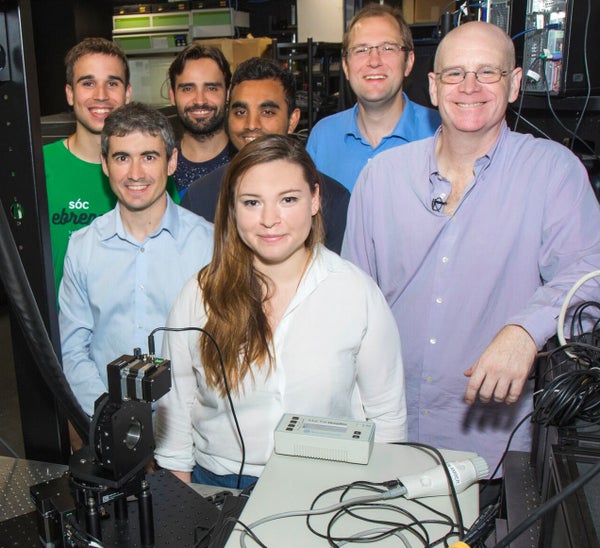
Stephen Macknik with his lab's ocular robot. Credit: SUNY Downstate Medical Center Office of Communications and Marketing
On supporting science journalism
If you're enjoying this article, consider supporting our award-winning journalism by subscribing. By purchasing a subscription you are helping to ensure the future of impactful stories about the discoveries and ideas shaping our world today.
The way the brain makes eye movements— to the right place and at the right time—to achieve this incredible feat is a hot topic of study in neuroscience, including in my lab. My university recently filmed me as I gave a tour of my lab, describing one of our approaches to vision research that relies on an advanced ocular robot. I thought you might enjoy taking the tour with me, to see one way that neuroscientists study oculomotor function.
A tour of the Macknik lab, and its current approach to oculomotor function.
Credit: SUNY Downstate Medical Center, Office of Communications and Marketing.