
This article was published in Scientific American’s former blog network and reflects the views of the author, not necessarily those of Scientific American
Is it possible to change public opinions, attitudes, and beliefs, through schooling, advertisement, or any other means? A study published two weeks ago in PNAS shows that Nazi indoctrination of antisemitic attitudes in Germany was extremely effective.
The researchers analyzed data from two waves of the General Social Survey for Germany (ALLBUS 1996 and 2006), which asked the following seven questions concerning attitudes about Jews:
Do Jews have too much influence in the world?
On supporting science journalism
If you're enjoying this article, consider supporting our award-winning journalism by subscribing. By purchasing a subscription you are helping to ensure the future of impactful stories about the discoveries and ideas shaping our world today.
Are Jews responsible for their own persecution?
Should Jews have equal rights?
Do you feel ashamed about German crimes against Jews?
Do Jews exploit their victim status for financial gain?
How do you feel about a Jew marrying into your family?
How would you feel about having a Jewish neighbor?
Each of the questions required a numerical response ranging from 1 to 7. The scientists recoded the scale after the survey, so that 7 corresponded to the most anti-Semitic responses.
The combined waves included responses from 5,300 people with German parents and grandparents, from 264 towns or cities. The results were disheartening: 17% of respondents indicated that Jews should blame themselves for their own persectution, 25.7% did not like the idea of a Jew marrying into their family, and 21.5% thought that Jews should not have equal rights to non-Jews (scores of 5 or higher). There were large regional differences in attitudes: whereas 10% of Hamburg respondents felt that Jews should not have equal rights, 48% of those in Lower Bavaria felta that way. Other questions produced similar results. Overall, the survey indicated that one quarter of the German population holds negative opinions of Jews, ranging from mild to strong.
The researchers also identified commited anti-Semites, defined as those who answered 6 or higher to the questions asking, “Do Jews have too much influence in the world? Are Jews responsible for their own persecution?, and Do Jews exploit their victim status for their own advantage?”. Overall, 4% of the German population were classified as commited anti-Semites. Half of the 264 towns and cities surveyed had no committed anti-Semites, but in 10% of the locations they constituted 15% of all respondents.
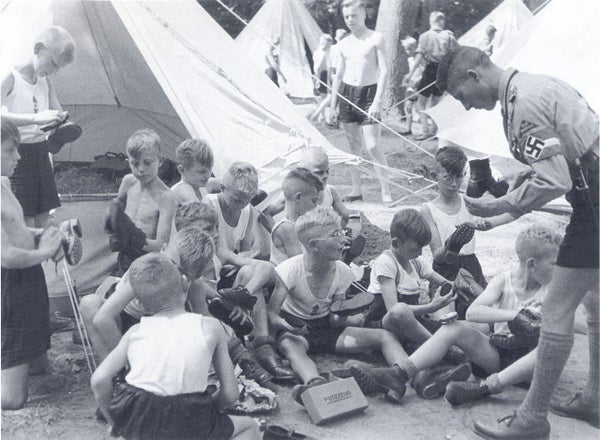
Next, the scientists wondered about the effects of growing up under Nazi rule on later-life attitudes about Jews. This was an important question, given the extensive indoctrination of racial hatred in Nazi schooling and extracurricular activities. Not only biology classes, but the entire academic curriculum was devoted to instill in the young a sense of the importance of race and the inferiority of Jews, blacks, and other groups. School attendance was mandatory for young Germans, as was joining the Hitler Youth. Racial ideology was the subject of 45 out of 105 pages in the Hitler Youth’s official handbook.

Cover and Backside from the book of the German Hitlerjugend: Pimpf im Dienst (Pimpf on Duty – used by the Pimpf-subsection of the Hitler Youth). Source: Wikimedia Commons.
The results of the survey showed that Germans that grew up under the Nazi regime remain, half a century later, markedly more anti-Semitic than people born in the decades before or after.

Share of committed anti-Semites by birth decade. The figure shows the proportion of respondents who answered with 6 or more (on a scale of 7) the questions, Do Jews have too much influence in the world?, Are Jews responsible for their own persecution?, and Do Jews exploit their victim status for financial gain?
The data indicated an overall downward trend: people born in later decades are less anti-Semitic than those born at the beginning of the 20th century. Yet, there was a striking outlier: respondents born in the 1930s, who were between 6 years old by the end of WWII, were three times more anti-Semitic than people born after 1950, and more than twice as anti-Semitic as those born in the preceding and following decades. [People born in the 1920s were also exposed to Nazi indoctrination, the authors note, but young male extremists could have become war casualties in significant numbers, by volunteering for the Waffen-SS, which had very high casualty rates].
The researchers concluded that Nazi schooling was the most effective tool for fostering racial hatred, and not radio or cinema propaganda, as one might have assumed. (Such indoctrination was particularly strong where schooling could tap into preexisting prejudices.) As depressing as the results of this study are, this last finding gives reason for hope, particularly at a time in which racial inequality remains an area of great concern in the US.
Social attitudes, perception, and beliefs are not only movable, but can be hugely modified through policy intervention.