
This article was published in Scientific American’s former blog network and reflects the views of the author, not necessarily those of Scientific American
The new play "The Neurology of the Soul," by Edward Einhorn, is a love story about an ex-artist named Amy who participates in an experimental study conducted by her husband, a cognitive neuroscientist named Stephen. I'm sympathetic to Stephen for several reasons, including our good taste in careers, first names and a variety of neuroscience matters. Stephen attempts to leverage his off-the-books research (about the love between himself and Amy) for its value to the marketing world. You know, to help make shoppers fall in love with the marketed products. It’s the Holy Grail of the neuromarketing world, as one character in the story extolls. Along the way, hilarity ensues, then tragedy, then redemption. The acting is excellent, and the direction and writing superb. My summary reveals little because I want you to go see it… it is truly worth your time.
Now that I've done the marketing part of this post, where I've utilized specific rhetoric and reference to emotion to manipulate you and get you to buy buy buy tickets, I can tell you what I myself found to be truly cool about the play. It was the science, which the performance is rich in, despite its theatrical format. The story starts off with Amy in an MRI scanner, undergoing a procedure called fMRI (the f stands for "functional"), so that Stephen can determine where—in Amy's brain—the circuits responsible for love reside. The idea being that once you know the neural location of the love circuitry, and determine how they are activated, you can also know with high accuracy the things that people around love, even if they don't want to tell you. The problem is, you may not love the answer.
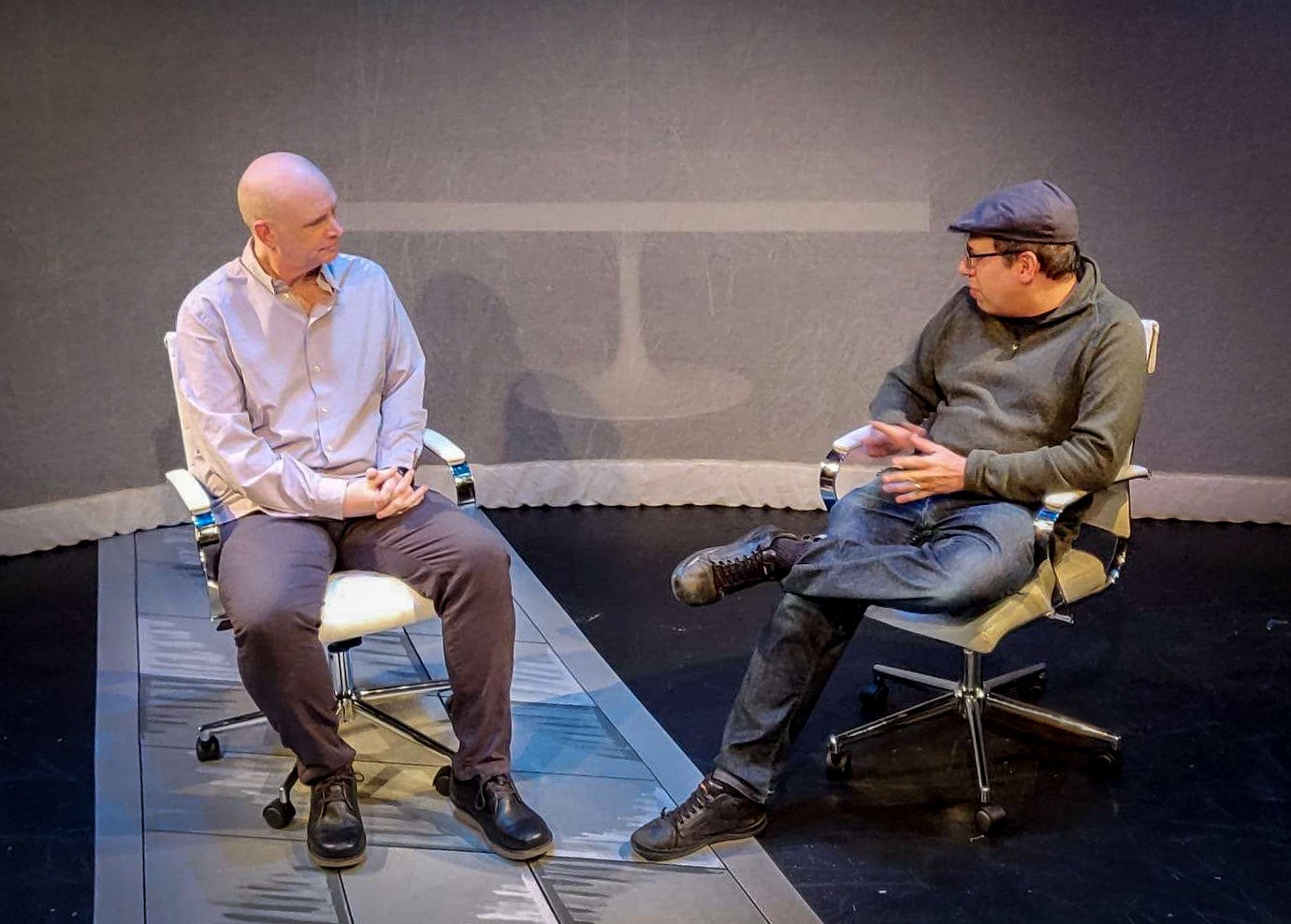
Stephen Macknik and Edward Einhorn discuss neuroscience after the play. Credit: Jordi Chanovas
On supporting science journalism
If you're enjoying this article, consider supporting our award-winning journalism by subscribing. By purchasing a subscription you are helping to ensure the future of impactful stories about the discoveries and ideas shaping our world today.
And *that* brings up the issue of ethics. Is it ok to scan someone's brain for their feelings about something specific, to find out what they are And *that* brings up the issue of ethics. Is it ok to scan someone's brain to find out what they are thinking, without giving them the ability to communicate it to you through the normal machinery humans use? Their preferred choice might be to deceive you about their most intimate feelings. Which could be to your benefit. What if you scan them and determine they love you, but then don't love you, but then that too is transient (for whatever reason), and you jump to the wrong conclusion? It would be like Romeo and Juliet, but with a foolproof lie detector that's gone awry.
Writer/director Einhorn handles the depths of these kinds of dilemmas with an impressive ease. As a neuroscience writer, I can attest that this is difficult to achieve. Even more impressive is how the play address many different interesting neuroscience questions, including pareidolia (seeing meaning in noise, as in a Rorschach image), cognitive bias (for example, perceiving intent where none exists), and last but not least, the neural bases of emotion, consciousness, influence from rhetoric, suggestibility, and motivation.
I saw the play on Sunday Feb 10, and then had the pleasure of joining Edward Einhorn on the stage to discuss, and answer questions from the audience, about the cognitive neuroscience in the play. I had a lot of fun, and I want to share with you that this Sunday, Feb 17, Susana Martinez-Conde (herself both a cognitive neuroscientist and a woman in love with a cognitive neuroscientist named Stephen) will be giving the TalkBack session.
Happy Valentine’s Day!