
This article was published in Scientific American’s former blog network and reflects the views of the author, not necessarily those of Scientific American
Most of us look at a bird and see its avian shape in perfect alignment with the colors of its beautiful plumage. How could it be any other way? The shape and color are derived from the same object and so the brain must process shape and color together as a unified percept. Right?
Wrong. The brain processes forms and color in separate neural circuits, but because these brain regions communicate with each other, our perception appears unified.
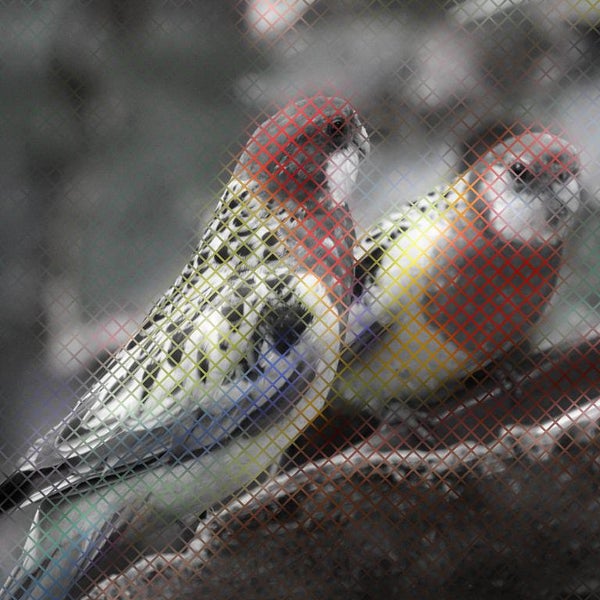
To understand how this all works, let’s do an experiment on ourselves to separate (and then recombine in our brains) the colors and shapes from an image. We will use an illusion called the Color Assimilation Grid, developed by Øyvind Kolås, a digital media artist and software developer.
On supporting science journalism
If you're enjoying this article, consider supporting our award-winning journalism by subscribing. By purchasing a subscription you are helping to ensure the future of impactful stories about the discoveries and ideas shaping our world today.

Credit: Steven Dakin (original Eastern Rosellas image from www.animal.photos)
First, let’s apply a screen to the birds (above) so that we can sample their colors but get rid of most of their shape information. We simply take the original image and blur it (to break down the shape information, not shown) and then multiply the resultant pixels in a step-by-step, pixel-by-pixel fashion with a grid screen of the same size as the original image. In the screen, white pixels equal 1 and the gray regions equal zero, so the result is a blurry colored plaid sample of the birds’ colors.
.jpg?w=1795)
Credit: Steven Dakin (original from www.animal.photos)
Now that we have diminished the shape information and sampled the colors, we need to do the opposite: sample the shapes after diminishing the color information, so that we can later mix the two to see how shape and color assimilate in the brain. To create the shape-only image we first turn the original image to grayscale (above) and then we apply the inverse of the screen we used in the color sampling. The result is a grayscale image of the birds with the shape information preserved, superimposed with a tiny grid of empty spaces where we can later add color information without altering the rest of the image.

Credit: Steven Dakin (original from www.animal.photos)
Finally, we add the products of the two previous processes (the Blurry Colors image and the Gray Shapes image). As we do that, notice that none of the information in either image overlaps in space with the other image, thanks to the screening process that carefully separates the pixels from the two images—and presto! we get the Color Assimilation Grid Illusion. The birds are mostly gray but appear to be colored throughout, because our brains take the tiny grid of color information and spread it liberally throughout the image, even over the gray parts! This perceptual phenomenon supports the notion that our brain's circuits process shape information in a precise fashion, while processing color information in a smeary imprecise way that is pasted onto the shapes as needed… as if after the fact.
You can learn more about the Color Assimilation Grid Illusion, and how it relates to art and other perceptual effects in our new Illusions column in this month's Scientific American MIND (Nov-Dec 2019).
Further Reading:
Susana Martinez-Conde and Stephen Macknik (2019), Chasing Rainbows. NOVEMBER /DECEMBER | MIND.SCIENTIFICAMERICAN.COM