
This article was published in Scientific American’s former blog network and reflects the views of the author, not necessarily those of Scientific American
Paleontologists sometimes call hadrosaurs “the cows of the Cretaceous.” These shovel-beaked herbivores were common, numerous, and, if we’re honest, at least partly famous as fodder for the carnivorous giants of their time. Whether they tasted anything like beef is a question beyond our current abilities to discern, but it seems they were delictable enough to the tyrannosaurs who were the top predators of the same times and places. A bitten bone from the Treasure State indicates that even little tyrants had a taste for duckbills.
The fossil, described by paleontologists Joseph Peterson and Karsen Daus, belongs to a partial hadrosaur skeleton found in the Hell Creek Formation of Carter County, Wyoming. It’s a caudal vertebra, or part of the tail, and what makes it stand out is a pair of oval punctures driven into the bone. These weren’t made by a misguided pickaxe or preparator’s tool. These are bite marks. The question is who was doing the biting.
Late Cretaceous Montana was home to an array of carnivores. There were raptors of varying size, crocodiles, and, of course, Tyrannosaurus rex. The shape of the punctures rule out the first two groups. The teeth of dromaeosaurids are too small and don’t match the shape, and a crocodile bite would have left a different pattern. This makes T. rex the top contender, Peterson and Daus write, but this Cretaceous crime scene wasn’t created by an adult. This was the work of a teenager.
On supporting science journalism
If you're enjoying this article, consider supporting our award-winning journalism by subscribing. By purchasing a subscription you are helping to ensure the future of impactful stories about the discoveries and ideas shaping our world today.
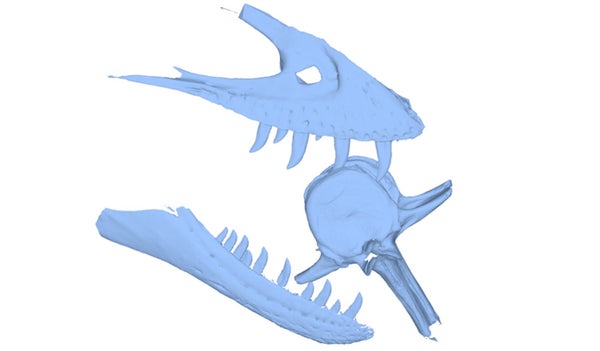
T. rex is one of the best-sampled dinosaurs we know of, including fossils representing life stages from juvenile to adult. The skeleton of “Jane,” in particular, is about as good a look as we’re going to get at an adolescent T. rex. (Some might contend that “Nanotyrannus,” a pint-sized tyrannosaur, might be a suspect, but there is no definitive evidence that this dinosaur existed. The specimens proposed as “Nanotyrannus” are exactly what we would expect of young T. rex, and that remains the state of the science.) And, as luck would have it, the teeth of “Jane” are a close match the bite marks on the hadrosaur vertebra. The youngster chomped hard enough to leave its mark in bone.
This adds a new wrinkle to the T. rex saga. The “tyrant king” really did rule its environment - it was the only large carnivorous dinosaur in the Hell Creek and equivalent formations. Part of this might be because T. rex changed so dramatically with age, meaning that juvenile and subadult T. rex might have taken up the ecological space normally occupied by other species of carnivorous dinosaur, perhaps munching on different prey as they grew up. But the correspondence between the bite marks and the jaws of “Jane” indicate that by around 11 years old, at the latest, young T. rex were already starting to get the most from carcasses. They didn’t yet have the bone-crushing bites of adults, but they weren’t necessarily shy about biting deep and scraping bone. This was practice for breaking down bodies even further, pulverizing prey in a way few other dinosaurs were capable of.