
This article was published in Scientific American’s former blog network and reflects the views of the author, not necessarily those of Scientific American
I’m fascinated by the typology of nature, the form of wilderness that we carry around in our heads. That's because what we expect doesn't always match reality. Our species has a penchant for reductionism, boiling down concepts and creatures alike to their essence so that we can quickly and efficiently exchange ideas. I can say “tiger” and you know exactly what I mean. But whether we take the average or exceptional as normal, we’re missing the variability that allows life to thrive. Consider a black maned wolf seen in Brazil.
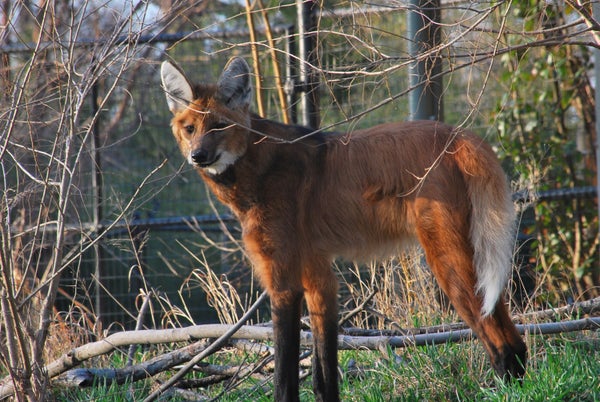
Maned wolves are favorites of zoos and documentaries alike. Their long legs give them a charming strut and they’ve often called “foxes on stilts.” The truth of the matter is that they’re not particularly close to foxes, wolves, or any other dog. Their closest relatives on the canid family tree are the bush dogs, but, given that bush dogs are in a totally different genus, there’s not much resemblance between the two. Chrysocyon brachyurus, as it's known to zoologists, is truly a unique beast.
Still, it’s hard to look at a maned wolf and not come away with the fox on stilts impression. The maned wolf independently evolved a reddish pelt that descends to black along the legs and a tuft of white on the tail. This was thought to be the standard coloration for the species over its South American range. But now zoologist Guilherme Ferreira and colleagues have reported the first black-phase maned wolf ever recorded.
On supporting science journalism
If you're enjoying this article, consider supporting our award-winning journalism by subscribing. By purchasing a subscription you are helping to ensure the future of impactful stories about the discoveries and ideas shaping our world today.
The evidence came from camera traps. While reviewing photos from a zoological survey of Veredas do Acari Sustainable Reserve in Brazil, the zoologists counted 25 images of maned wolves in their expected attire. But five of the photos showed a black maned wolf, presumably all the same individual. No one had seen a black maned wolf before, even in captivity.
You can have a look at the dark wolf in the official field report. This canid, which may be the only one of its kind, looks less like a fox on stilts and more like a leggy lycanthrope, the unusual nature of its anatomy highlighted by the shift in color. The fact that it was only photographed at night might help explain why such wolves have eluded detection before. They are shadows on shadow.
But why is this maned wolf black? Most canids with black coats or black variations are from the Canis genus that includes wolves, coyotes, and the domestic dog. In fact, black coats in wolves and coyotes probably spread thanks to interbreeding with domestic dogs over the past 50,000 years, millions of years after maned wolves last shared a common ancestor with them. And given that no known hybrids between dogs and maned wolves exist, the zoologists propose, something else is at work. The jet-black maned wolf might express a mutation that allowed the adult animal to retain its darker, juvenile coat, although genetic research would be required to be sure.
And just like that, maned wolves are not the same as we always expected them to be. Yes, the typical image is still of a rust-colored canid trotting through scrubby clearings, but that image isn’t all of what maned wolves are, or even can be. Their evolution continues, challenging whatever neat and clean definitions we might prefer.