
This article was published in Scientific American’s former blog network and reflects the views of the author, not necessarily those of Scientific American
I’ve always had a fondness for Basilosaurus. Despite the name, the “king lizard” is really an Eocene whale. For decades, it’s stood in as a critical part of the transcendent evolutionary example of how whales went from landlubbers to streamlined seagoers. But it’s the teeth that gripped my young mind when I first saw the classic Charles R. Knight depiction of the beast. The whale’s mouth looked too big, its teeth oversized and ready to nab whatever might pass by. Basilosaurus didn’t have a deceptive grin, like a dolphin, nor the tight-lipped look of a baleen whale. This was a whale that looked like it might eat me if it hadn’t gone extinct over 34 million years ago, and, in fact, gut contents from a Basilosaurus found in Egypt confirm that this cetacean had no qualms about munching on other large mammals.
The notion that Basilosaurus consumed flesh has never been in question. The pointed, conical teeth at the front of the jaw and the shearing cheek teeth left paleontologists with no doubt that Basilosaurus feasted on fish, and possibly other vertebrates. But dental anatomy can only hint at possibilities, not actual menu items. Confirming what extinct species actually ate relies on careful analysis of other lines of evidence, in this case fossils-within-a-fossil described by paleontologist Manja Voss and colleagues.
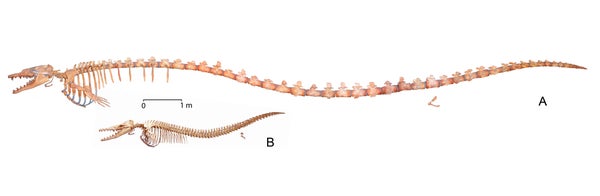
The Basilosaurus skeleton at the center of the study was found in 2010 at Wadi Al Hitan, Egypt. This is “Whale Valley,” famous for its abundance of Eocene cetaceans. In this case, a mapping project uncovered the bones of the local Basilosaurus species - Basilosaurus isis - that came with some surprises. Mixed among the skeleton were the remains of a large fish called Pycnodus, part of a shark tooth, the remains of a smaller early whale called Dorudon. The shark tooth may have come from a scavenger, but the rest, Voss and coauthors propose, are gut contents from what the Basilosaurus consumed shortly before death.
On supporting science journalism
If you're enjoying this article, consider supporting our award-winning journalism by subscribing. By purchasing a subscription you are helping to ensure the future of impactful stories about the discoveries and ideas shaping our world today.
Paleontologists already suspected that Basilosaurus fed on large fish and other whales. Gut contents from another Basilosaurus species - Basilosaurus cetoides - showed this whale ate sharks and large fish. And Dorudon skulls previously found at Wadi Al Hitan show bite marks most likely made by Basilosaurus. But the stuffed skeleton brought these lines of evidence together, marking Basilosaurus isis as the apex predator of its time.
The find highlights what might have been a regular occurrence in the local waters over 34 million years ago. All the Basilosaurus skeletons known from Wadi Al Hitan represent adults, Voss and coauthors write, while about half the Dorudon are juveniles. Back in the Eocene, Wadi Al Hitan may have been a place where Dorudon calved and raised their offspring. Lurking Basilosaurus may have taken advantage of this, preferentially targeting young Dorudon and quickly incapacitating them with bites to the skull. The Basilosaurus grin that transfixed me as a child just got much creepier.