
This article was published in Scientific American’s former blog network and reflects the views of the author, not necessarily those of Scientific American
Whether we’re focused on a skeleton, isolated tooth, or an ancient impression, a fossil is often talked about as a discrete entity. It’s something singular, self-contained and pertaining to just one species or story from the annals of natural history. But this isn’t always so. Sometimes paleontologists encounter interwoven aspects of prehistory, a point where long lost lives intersected. Consider bite marks.
Bite marks technically fall under the category of trace fossils. That is, remnants of ancient life that record the behavior of organisms. In the case of bite marks, though, the punctures and furrows have to be left on some sort of surface - just as surely as a footprint had to be impressed into the ancient sediment - and, often, that substrate is bone. David Hone, Darren Tanke, and Caleb Brown describe one such trace in a new study - evidence of how a young horned dinosaur wound up as a Cretaceous snack.
The specimen in question, known by its catalog number TMP 2014.012.0036, was found in the roughly 75 million-year-old strata of Alberta’s famously fossil-rich Dinosaur Park Formation. It was likely once part of the common herbivore Centrosaurus, or a similar ceratopsid. Compared to the stunning skeletons that have come from this place, the broken frill bone - part of a squamosal - might not look like very much. But two interrelated factors make the bone noteworthy. The bone is from a subadult animal, and it has bite marks on it.
On supporting science journalism
If you're enjoying this article, consider supporting our award-winning journalism by subscribing. By purchasing a subscription you are helping to ensure the future of impactful stories about the discoveries and ideas shaping our world today.
Even though horned dinosaur bones bearing this particular kind of dino damage have been found before, Hone and coauthors write, bite marks on a subadult ceratopsid skeleton haven't been reported until now. At least two of the marks on the fossil can be “confidently interpreted as bite marks.” The question, as ever, was who was doing the eating.
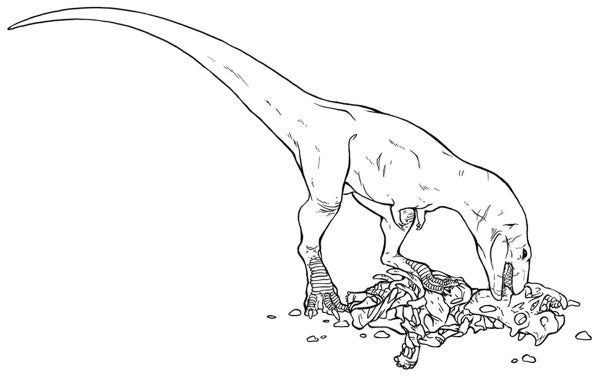
One of the challenges with interpreting the bite marks of carnivorous dinosaurs is that, despite differences in tooth anatomy, these meat-eaters were chomping in similar ways. That is, their teeth often acted in a puncture-and-pull motion. This means very different carnivores could have left similar bite marks. Based on the size and shape of the furrows on the frill bone, however, Hone and colleagues propose that the bone was bitten by either a dromaeosaur (think something in the form of Velociraptor), a young tyrannosaur, or possibly both.
And there’s a little more to this than who was eating whom. The bite marks show no signs of healing, indicating that they were made at the time of death or after. Given that the squamosal bones of horned dinosaurs did not have much meat or other fleshy resources to offer, though, Hone and coauthors suggest that the bite marks represent scavenging when most of the rest of the young ceratopsid’s body was already picked over. Perhaps what little remained on this shard of Centrosaurus provided a tiny morsel that only made a Cretaceous carnivore’s stomach grumble as they moved on to search for something more.