
This article was published in Scientific American’s former blog network and reflects the views of the author, not necessarily those of Scientific American
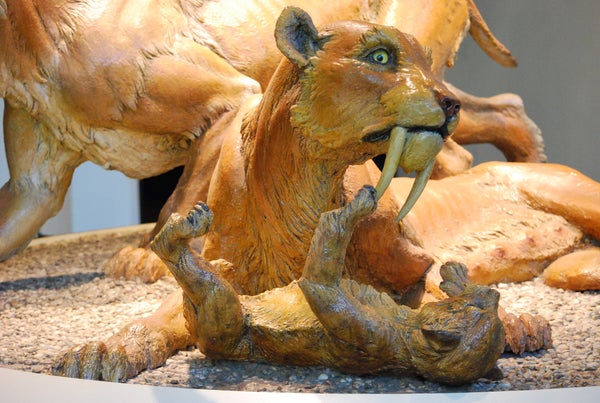
Once upon a time, not so very long ago, there were saberkittens. I’m absolutely tickled by the thought of the little biters playing and rolling about the Ice Age world, especially during their protracted teething phase. But while – at least in broad terms – a cat is a cat is a cat, there’s no living feline quite like the sabercats of old, and even Smilodon cubs bore specializations that presaged the burly adults they grew up to be.
Paleontologists have known that Smilodon had extraordinarily powerful arms for a while now. The work of paleontologists Julie Meachen and Blaire Van Valkenburgh, in particular, has pinned down how important strong arms were to this cat's predatory prowess. But how did the cats develop this ability as they grew? To answer that, paleontologist Katherine Long and colleagues looked to the anatomy of immature Smilodon from the famous La Brea asphalt seeps.
What the researchers were looking at was a trend called allometry, or the relationship between the size of an organism and the parts that make it up. In other words, it’s a way of studying how proportions change, in this case focused on the forelimbs of young Smilodon compared to those of other cat species. And what the paleontologists found came as something of a surprise.
As far as forelimbs go, Long and colleagues write, Smilodon kittens grew more or less the same way that other cats do. Their arms grew longer at a faster rate than they grew thicker, giving them an overall slender appearance. It's the classic cat pattern. But little Smilodon differed from other cats in one significant way.
The arm bones of little Smilodon appear more robust than those of other kittens of the same age. What this means, Long and coauthors propose, is that Smilodon kitten arms started out bulkier and maintained that against the background of the typical way cats grow. They had burly arms almost from the start and carried the trend on as they got older. That would definitely be a reason to carefully consider giving a cute little saberkitten a belly rub, if de-extinction ever gave you the chance. They might not give you your hand back.
On supporting science journalism
If you're enjoying this article, consider supporting our award-winning journalism by subscribing. By purchasing a subscription you are helping to ensure the future of impactful stories about the discoveries and ideas shaping our world today.
Reference:
Long, K., Prothero, D., Madan, M, Syverson, V. 2017. Did saber-tooth kittens grow up musclebound? A study of postnatal limb bone allometry in felids from the Pleistocene of Rancho La Brea. PLOS ONE. doi: 101371/journal.pone/0183175
