
This article was published in Scientific American’s former blog network and reflects the views of the author, not necessarily those of Scientific American
Ice Age mammals loom large in our imagination. It’s easy to envision a complete collection of mammoths, giant camels, short-faced bears, dire wolves, giant ground sloths, and sabercats filling the Pleistocene world, standing shoulder to shoulder. Museum exhibits and Who’s Who illustrations compound the perception, showing these animals as if gathered for a bestial convention.
But the fact is that many of our Ice Age favorites weren’t omnipresent during the Pleistocene, or inhabited the same places at the same time. In ancient North America, for example, mammoths and American mastodons generally preferred different types of habitats and local conditions. The pachyderms overlapped in time, certainly, but they didn't necessarily call each other "neighbor." It takes fossil detective work to figure out who was where when, and what that means for ecological patterns of everything from food webs to extinction. And we still have a lot left to learn. Just this month, for example, paleontologist Ashley Reynolds and colleagues announced the first Smilodon fatalis ever found in Canada.
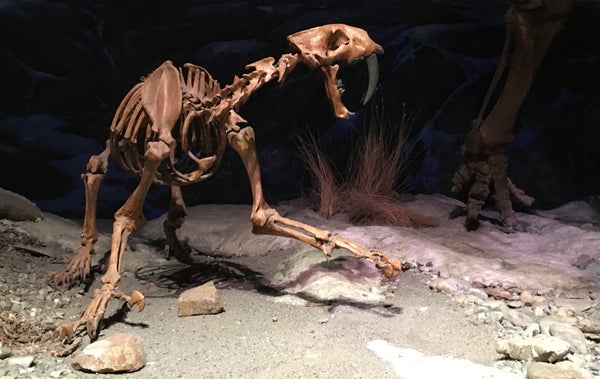
Smilodon fatalis is North America’s iconic sabercat. Even though South America’s Smilodon populator was larger, perhaps the biggest cat of all time, Smilodon fatalis got a fame boost from the sheer number of skeletal parts exhumed from California’s famous La Brea asphalt seeps. Not that the cat was endemic to LA. Smilodon fatalis ranged across North and Central America, as far north as Idaho and as far south as Florida in the United States and from Mexico to Uruguary to the south. But towards what’s now the Canadian border, the cat’s fossil trail seemed to disappear.
On supporting science journalism
If you're enjoying this article, consider supporting our award-winning journalism by subscribing. By purchasing a subscription you are helping to ensure the future of impactful stories about the discoveries and ideas shaping our world today.
Fossils found in Medicine Hat, Alberta change that. The fossils themselves were collected in the 1960s along the South Saskatchewan River, but, as Reynolds and coauthors note, the cat bones that were plucked up were never properly described. Upon examination, the cat remains in this one place represent several species – lynx, the American lion Panthera atrox, the cave lion Panthera spelaea, and Smilodon fatalis.
(The discovery of the American lion and cave lion in the same place is also noteworthy, not just for expanding the range of cave lions into southern Alberta but also driving the point that paleontologists should carefully evaluate their appraisal of lion remains in North America given there are two species in play.)
Verified Smilodon remains from Canada have never been reported before. Around 42,000 years ago, this cat roamed southern Alberta. The conclusion of Reynolds and colleagues leads to a significant range expansion for Smilodon fatalis, the new find situated over 600 miles north of the previous record holder.
The discovery doesn’t necessarily mean we can imagine Smilodon slipping around Canadian glaciers. Smilodon fatalis appears to have preferred warmer conditions, its range expanding and contracting according to the build and thaw of glaciers. Smilodon spread during warmer periods, as the ice shrunk back, and was more confined when glaciers grew. And this fact may help paleontologists find additional specimens. By searching strata or collections that represent the warmer, non-glaciated times in southern Canada, more Smilodon may appear.