
This article was published in Scientific American’s former blog network and reflects the views of the author, not necessarily those of Scientific American
Zoologists have a special word for animals adapted to crushing hard-shelled foods. These species are called durophages – the “hard eaters.” The seagoing lizard Globidens, for example, had bulbous teeth that the mosasaur used to crunch marine invertebrates back in the Cretaceous. Today’s spotted hyena can be considered a durophage for its amazing ability to crush bones to splinters. Horns sharks bust open crabs with their molar-like teeth. Durophages aren’t a natural family group, but have evolved over and over again throughout time in their own particular ways. Now researchers have identified the oldest cruncher yet uncovered among our four-limbed vertebrate family.
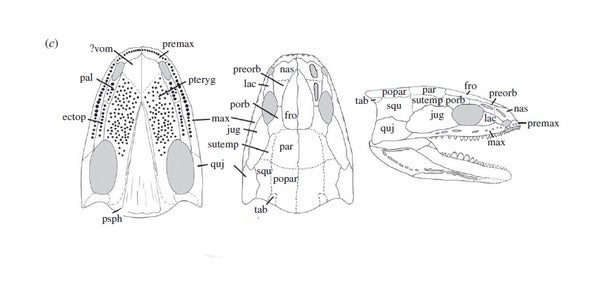
The creature isn’t new to science. Called Acherontiscus caledoniae, this roughly 323 million-year-old tetrapod is known from a single specimen collected in the 19th century and was named in 1969. But a new analysis of Acherontiscus conducted by paleontologist Jennifer Clack and colleagues has revealed this vertebrate’s anatomy in unprecedented detail, including stout, rounded teeth that varied along the jaw.
While it’s possible an even older shell-crunching tetrapod will be found, Acherontiscus currently holds the title and may retain the honor. This vertebrate belonged to a radiation of more-or-less amphibious vertebrates that proliferated after the evolution of limbs tipped in digits and during the time when tetrapods were making themselves at home on land.
On supporting science journalism
If you're enjoying this article, consider supporting our award-winning journalism by subscribing. By purchasing a subscription you are helping to ensure the future of impactful stories about the discoveries and ideas shaping our world today.
The early Carboniferous was such a time of evolutionary experimentation, in fact, that some animals technically classified as tetrapods lost their limbs. Acherontiscus is one of these snake-like forms, and its teeth further underscore how much had changed from the time of Tiktaalik. Earlier tetrapods had spike-like teeth that were essentially the same along the jaw. That an animal like Acherontiscus evolved by 323 million years ago to tackle a new diet underscores how vertebrates were creating new niches for themselves in ways never seen before.
What was Acherontiscus eating? The fare must have been small bites. The skull of the tetrapod, Clack and coauthors write, is less than half and inch long. Acherontiscus was small and is thought to have been water-bound, meaning that millipede-like invertebrates on land were probably not suitable appetizers. Small, water-dwelling crustaceans are a better bet, and we can imagine Acherontiscus squirming through the swampy waters of the ancient, equatorial rainforest of its time, chomping its way towards eventual evolutionary fame.