
This article was published in Scientific American’s former blog network and reflects the views of the author, not necessarily those of Scientific American
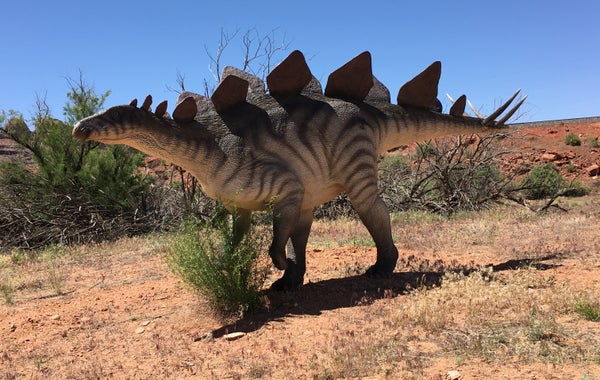
Stegosaurus is a rock star. The spike-tailed, highly-decorated dinosaur is one of the most famous Mesozoic creatures ever found, thanks in no small part to its initial scientific discovery during the 19th century’s Bone Wars and persistent appearances in the Jurassic Park franchise. But Stegosaurus was just one of the last, largest, and strangest of a family that paleontologists have been tracing deeper into the Jurassic. Paleontologists Susannah Maidment, Thomas Raven, Driss Ouarhache, and Paul Barrett have now added another wrinkle to the story.
In Jurassic Morocco, about 168 million years ago, there roamed a stegosaur. It’s not only the first of its kind to be found in northern Africa, Maidment and colleagues note, but to date this animal is the oldest definitive stegosaur to be discovered. The paleontologists have named the animal Adratiklit boulahfa, the “mountain lizard from Boulahfa.”
So far, relatively few bones of Adratiklit are known. The first described parts of the dinosaur are several vertebrae and an upper arm bone. But, as the researchers point out, there is no mistaking these parts as belonging to another group of dinosaurs. Adratiklit is certainly a stegosaur.
On supporting science journalism
If you're enjoying this article, consider supporting our award-winning journalism by subscribing. By purchasing a subscription you are helping to ensure the future of impactful stories about the discoveries and ideas shaping our world today.
Experts are likely to uncover even older stegosaurs – Isaberrysaura, named in 2017, might be a stegosaur from even older rocks – but, for now, Adratiklit holds the title. More than that, the dinosaur turned up in a place where stegosaurs are rarely found. Most stegosaurs we know of have been found in the northern hemisphere, with relatively few found south of the Equator. Contrary to what you might expect, though, Adratiklit wasn’t closely related to Kentrosaurus or later stegosaurs found in Africa. Its closest relatives are from Jurassic Europe, highlighting how lineages of stegosaurs moved around the world.
There’s certainly more out there to find. The relative rarity of stegosaurs in the southern hemisphere probably isn’t because these animals themselves were scarce, Maidment and coauthors suggest, but because of the availability of relevant rocks and the way available exposures are sampled.
Despite the fact that southern continents seem to have comparatively fewer exposures where stegosaurs are likely to be found, the rock layers that do exist have yet to be studied in as much detail. And that's not to mention that time periods like the Middle Jurassic and Middle Cretaceous are poorly-studied in general. That means that there are certainly more dinosaurs to find, including bones that illuminate the dawn of the stegosaurs.