
This article was published in Scientific American’s former blog network and reflects the views of the author, not necessarily those of Scientific American
Sometimes it’s difficult to avoid feeling a little habituated to the wealth of dinosaur discoveries. Feather-covered dinosaurs are old news, and paleontologists have been gradually been coloring in the appearance of dinosaurs since 2010. (Not to mention an entire host of other revelations previously thought beyond the reach of paleobiology.) There are young dinomaniacs growing up now we don’t bat an eye at a fluffy Tyrannosaurus,who expect their raptors to be colored like crows or magpies. And that’s exactly why I like to think back to my own childhood fascination with dinosaurs - back during the 80s and 90s dinomania upswell - and appreciate discoveries that would have absolutely blown my little mind if I had known about them back then.
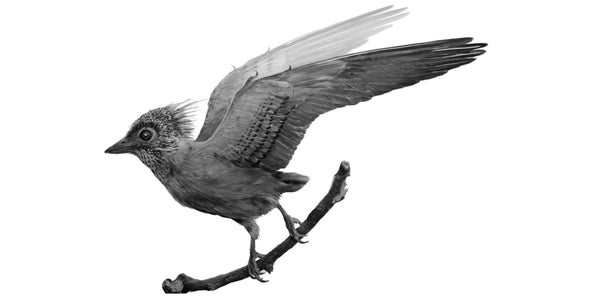
A study just published by Quanguo Li, Julia Clarke, Ke-Qin Gao, Jennifer Peteya, and Matthew Shawkey is a great example. Drawing from “an extremely well-preserved specimen of the Cretaceous bird Confuciusornis” - an avian dinosaur, lest we forget - the researchers have detected the patterns which once covered this prehistoric flapper’s plumage.
Confuciusornis is a wonderful fossil creature because so many specimens are known. This has not only allowed paleontologists to appreciate the variation of this bird, but the sheer number of Confuciusornis fossils found in sites of exceptional preservation have upped the chances of detecting delicate features that would have eluded us if the sample size was smaller. In this case, Li and colleagues studied a specimen known as CUGB P1401 for clues about the coloration of this long-lost avian.
On supporting science journalism
If you're enjoying this article, consider supporting our award-winning journalism by subscribing. By purchasing a subscription you are helping to ensure the future of impactful stories about the discoveries and ideas shaping our world today.
That CUGB P1401 has secrets to share is apparent right from the start. The feathers are preserved in fine detail, and some of the wing feathers even seem to show darker spots that could have been part of the bird’s color pattern in life. To be sure, though, Li and coauthors analyzed the chemistry and microscopic details of this fossil. This would reveal whether the patterns were biological or something that only happened after death due to some other phenomena.
As far as color goes, the paleontologists propose, this Confuciusornis likely had a grayscale look. This lines up with a previous analysis of another Confuciusornis specimen. But what’s special about CUGB P1401 is that the fossil preserves some flashy features not seen before. The researchers found evidence for large spots on part of the wings, striking feather patterns on the throat and lower leg, as well as a head crest.
These discoveries might help distinguish between different Confuciusornis species, or, paired with studies of bone microstructure, allow males and females of the same species to be identified. The question is what these patterns meant to the living bird. Were the spots meant to get attention? Or were they camouflage? And did the crest relate to courtship, threat displays, or something else? We don’t know yet, but the fact that we can ask these questions at all is wonderful. Confuciusornis - and other dinosaurs - will no doubt continue to change, but that is exactly why it’s worth stopping to appreciate, if we can, that the fossil record has so much more to tell us.