
This article was published in Scientific American’s former blog network and reflects the views of the author, not necessarily those of Scientific American
When we think of a dinosaur – or any animal, really – we often envision them as healthy adults in the prime of life. Yet, at the same time, we know that dinosaurs didn’t just pop into existence fully-formed. Each and every one started small, a hatchling just a fraction of the size of its parents.
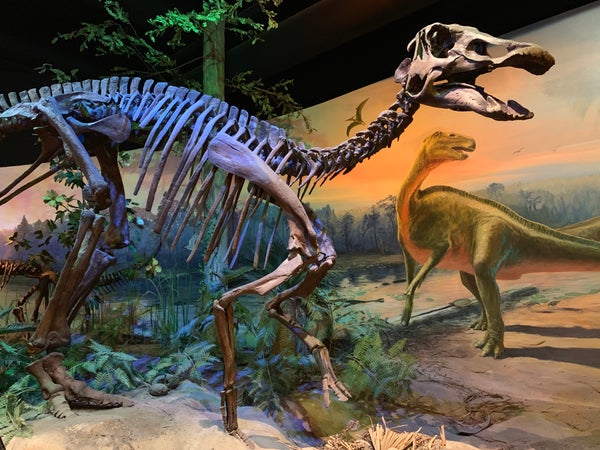
The fact that fossils revealing dinosaurian infancy are hard to find only intensifies the disconnect. There are dinosaurs that we’ve known from subadult or adult skeletons for over a century and yet we know almost nothing at all about what they were like when they hatched. Edmontosaurus, named in 1917, is one such example. Up until recently, the published record of the famous shovel-beaked dinosaur mostly consisted of large bones and skeletons. Now that’s changed.
Back in 2017, Mateusz Wosik, Mark Goodwin, and David Evans described a nestling-sizedEdmontosaurus specimen from the collections at the University of California Museum of Paleontology. The partial skeleton indicated that baby Edmontosaurus principally walked on all fours, just like adults, and there wasn’t a change in gait with age. Then, earlier this year, Andrew Farke and Eunice Yip described the femur of a juvenile Edmontosaurus that hints that this dinosaur grew up in a pattern similar to related, better-known hadrosaurs. Now Wosik, Goodwin, and Evans are back with nestling-size Edmontosaurus skull bones that outline how this dinosaur’s skull changed shape with age.
On supporting science journalism
If you're enjoying this article, consider supporting our award-winning journalism by subscribing. By purchasing a subscription you are helping to ensure the future of impactful stories about the discoveries and ideas shaping our world today.
The four bones, found in the Hell Creek Formation of northeastern Montana, are from multiple individuals. Each is part of a lower jaw, including the parts that held the dinosaur’s densely-packed teeth. And it’s these bones – the dentaries – that provide some insight on how age altered Edmontosaurus.
The dentary bones of hadrosaurs are very variable between one individual and another. Following from this, Wosik and colleagues write, the facial bones of these dinosaurs would have been variable, as well, meaning that young Edmontosaurus might look very different from each other. This matters in identifying hadrosaur material as part of an existing species or something new. Wosik, Goodwin, and Evans attribute the Hell Creek skull pieces to Edmontosaurus because it’s the only hadrosaur in the formation, but what about Alaska?
Late Cretaceous bones found in the far north were initially identified as Edmontosaurus, then reassigned to a new genus called Ugrunaaluk. But this determination was made on the basis of juvenile-age skull bones. If we know that juvenile Edmontosaurus were highly-variable in their skull shape during their youth, then it’s possible that the Alaskan fossils really do belong to Edmontosaurus, after all. Resolving the issue will require comparing adult material from Alaska to adult Edmontosaurus bones from further south, avoiding the anatomical squishiness of youth.