
This article was published in Scientific American’s former blog network and reflects the views of the author, not necessarily those of Scientific American
On supporting science journalism
If you're enjoying this article, consider supporting our award-winning journalism by subscribing. By purchasing a subscription you are helping to ensure the future of impactful stories about the discoveries and ideas shaping our world today.
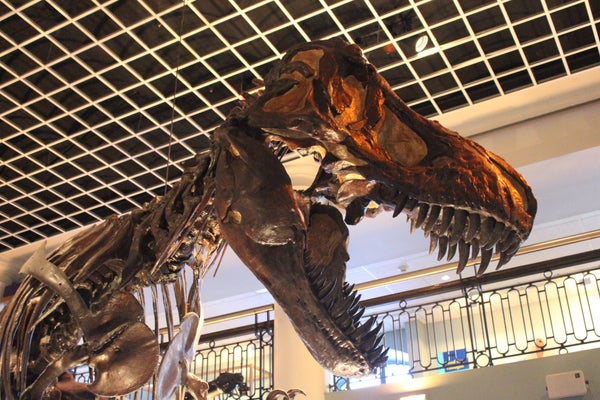
Standing in front of a Tyrannosaurus skeleton, it's hard to miss those long rows of fearsome teeth. Just think of what they did in life... From exhibits to art to movies, our imagination has been swallowed up in those jaws. But the next time you're lucky enough to safely stand in the presence of the tyrant king, take your eyes off the dental armory and look along the top of the carnivore's skull. There are bumps along the snout and over the eyes - ornamentation. It turns out Tyrannosaurus was a flashy dinosaur, and it wasn't the only giant predator with a sense of style.
Discussions of dinosaur ornamentation often center on the many-horned ceratopsids and the crested hadrosaurs. But theropod dinosaurs - the group that includes Tyrannosaurus as well as birds - had their own ways of showing off. And in a new paper, paleontologists Terry Gates, Chris Organ, and Lindsay Zanno conclude that significant differences in skull decorations were tied to body size.
Of the 22 largest theropod species with known skulls, the researchers write, 20 have some kind of ornamentation. Look at smaller theropods like Velociraptor, however, and the crests, bumps, ridges, and horns seem to be absent. You can see this just by looking at the skull themselves, but, digging deeper, Gates and colleagues found unexpected evolutionary patterns in their analysis. Not all ornamented theropods were giants - some were rather small - but the paleontologists concluded that lineages of theropods with display structures on their heads crossed the 2,200 pound barrier to giant size more often. Not only that, but lineages of ornamented theropods attained huge sizes faster than unornamented ones.

Ceratosaurus at the Natural History Museum of Utah. Credit: Brian Switek
These extravagant structures were not weapons. They were often very fragile and thin or shaped in such a way that they would have been totally ineffective for predation or combat. (Even among horned dinosaurs, those nasty-looking spikes typically had more to do with display than fighting.) These were social signals. Debate continues about whether this means these structures helped species identify members of their own kind, impress mates, intimidate rivals, indicate maturity, or some mix of various functions, but ornament really is an apt term for the triple horns of Ceratosaurus and the prominent flanges sticking out above the eyes of Carnotaurus.
Not that unornamented theropods didn't strut their stuff. They just did it differently. While the focus on the new study was on bony ornamentation, the authors also took into account that many of the "unornamented" theropod dinosaurs had complex feathers and protofeathers. Some of these crossed the boundary into giant size, and yet they didn't evolve bony ornaments that were fashionable among the tyrannosaurs and ceratosaurs. Dinosaurs like Velociraptor, Oviraptor, Struthiomimus, and others probably showed off to each other with feathery displays - think of Cretaceous fan dances - and had no need for cumbersome headgear.
Not all theropods were carnivorous - many ate plants, or were omnivores - but we adore the vicious ones. These were the dinosaurs that ate other dinosaurs, and we love to watch them do it. But the prevalence of ornaments adds another dimension to them. It's a reminder that these animals had social lives, as well, and were not just eating machines. Think of a Gorgosaurus spying the ornaments of another tyrannosaur in the distance, assessing whether it's a member of its own kind or a dangerous Daspletosaurus horning in on its territory, or a Deinonychus flashing its arm feathers to try to woo a potential mate. Ornaments, in bone or feather, are whispers of dinosaur lives.
Reference:
Gates, T., Organ, C., Zanno, L. 2016. Bony cranial ornamentation linked to rapid evolution of gigantic theropod dinosaurs. Nature Communications. doi: 10.1038/ncomms12931
