
This article was published in Scientific American’s former blog network and reflects the views of the author, not necessarily those of Scientific American
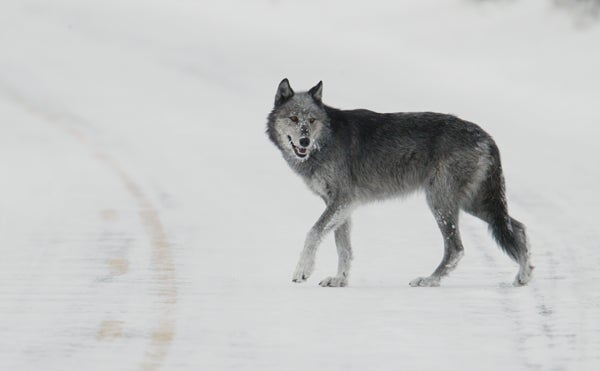
If you're lucky enough to hear a long, sonorous howl rolling through the Wyoming forests and grasslands, you're listening to the voice of a gray wolf. They're the only wolves padding around the Cowboy State today. But during the last Ice Age, a different sort of wolf called this range home. A wolf with stronger jaws, an appetite for megafauna, and one that paleontologists never expected to find so far south.
The bones that tipped paleontologists off to presence of the mysterious wolf were extricated from the depths of Natural Trap Cave. Expeditions in the 1970s, as well as a new project launched two years ago, have collected dozens of Ice Age wolf bones from the dark, humid pit. But what species was this wolf?
Up until now, Des Moines University paleontologist and Natural Trap Cave project leader Julie Meachen says, the wolves of the Wyoming boneyard were categorized as either gray wolves or dire wolves. These were the only suitable candidates, although no one seemed confident enough to make a determination between them. "When I looked at the collections," Meachen says, "they're all just labeled Canis" with no designation of whether the remains belonged to the burly dire wolf or the gray wolf familiar to us today.
On supporting science journalism
If you're enjoying this article, consider supporting our award-winning journalism by subscribing. By purchasing a subscription you are helping to ensure the future of impactful stories about the discoveries and ideas shaping our world today.
To solve the mystery, Meachen and her colleagues decided to look at lower jaws. "There are several good ones from Natural Trap," Meachen says, and her coauthor Alexandria Brannick had recently amassed a detailed photographic record of dire wolf jaws. All Meachen needed to do was measure some gray wolf jaws for comparison, and a serendipitious museum choice ended up leading to a surprising conclusion.
There are collections of gray wolves all over the country, Meachen says, but she chose the American Museum of Natural History for two reasons. Not only does the institution have wolves, Meachen says, but New York City seemed like a fitting destination for a vacation she was planning. Yet the wolves held in the AMNH collections were different than she anticipated. Many of the prehistoric wolves in the museum's collections belonged to a recently-recognized group called Beringian wolves.
The Beringian wolves are a reminder that there are still Ice Age surprises awaiting paleontologists. These wolves were only identified as something distinct in 2007, not only carrying a different genetic signature from gray wolves but looking much more like dire wolves than today's grays. Even though Beringian wolves are currently categorized as Canis lupus, in other words, their stocky anatomy and hypercarnivorous behavior would have made them much more like dire wolves in life.
The Beringian wolves added a new wrinkle to the project. Meachen was curious to see where the recently-discovered species fell amongst its two relatives. But as she ran her analyses, Meachen's Beringian wolf data turned out to be a lucky break. The Natural Trap Cave wolves were not dire wolves, nor were they gray wolves. They were Beringian wolves.
No one expected to find Beringian wolves so far south. They were thought to be beasts of ancient Alaska and the Yukon. Yet the Natural Trap Cave jaws clustered with the Beringian wolves rather than with the dire or gray samples.

The path of Beringian wolves to Natural Trap Cave. From Meachen et al., 2016.
Even though the result came as a shock, Meachen says that the presence of the Beringian wolves in ancient Wyoming fits. "It makes sense looking at the map and looking at where the glaciers were," Meachen says, being that "the corridor spits you at at NTC." The wolves trotted between the ice far further south than anyone ever knew.
Natural Trap Cave's Beringian wolves have only raised more questions about North America's Ice Age canids. Gray wolves are Eurasian natives, Meachen says, and no one knows whether they arrived before or after the Beringian wolves evolved. Then there's the matter of the dire wolves - while Beringian wolves were venturing further south, the famous dire wolves never seemed to venture above Oregon. This brings up new puzzles about how the wolves divvied up Pleistocene habitats and interacted. "We assumed that gray wolves came over from Eurasia and that was it. I think there's so much interplay now," Meachen says. Somehow North America's grays went from being just one of many canids to the continent's lone wolves.
Reference:
Meachen, J., Brannick, A., Fry, T. 2016. Extinct Beringian wolf morphotype found in the continental U.S. has implications for wolf migration and evolution. Ecology and Evolution. doi: 10.1002/ece3.2141
