
This article was published in Scientific American’s former blog network and reflects the views of the author, not necessarily those of Scientific American
The wayward chunk of space rock that smacked into the Earth 66 million years ago did more than decimate the dinosaurs. It also tipped the natural odds in favor of our placental ancestors.
Prior to the end-Cretaceous catastrophe, metatherians – marsupials and their close relatives – were the hot mammalian ticket, particularly in North America. Placental mammals had already split from their common ancestor with metatherians and been evolving for millions of years by this time, but it took a mass extinction to give them room to diversify. That context is part of what makes a new Eocene metatherian stand out.
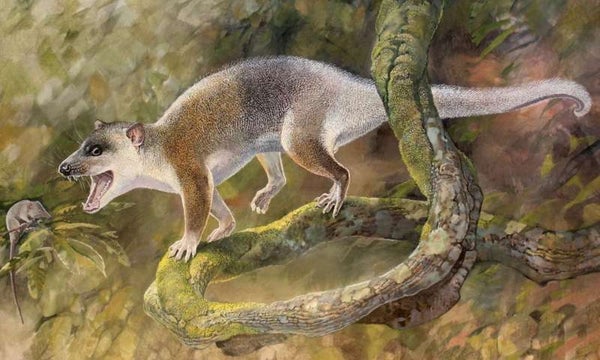
The ancient mammal, named Anatoliadelphys maasae by paleontologists Murat Maga and Robin Beck, lived in Turkey about 44 million years ago. It wasn’t quite like a modern marsupial, but belonged to the wider group of related animals called marsupialiformes. And when alive, Anatoliadelphys would have been about the size of a housecat, or, perhaps more appropriately given its family relationships, a spotted quoll. That might not sound particularly impressive for a time period when placental mammals were getting to rhino size and above, but it’s pretty damn good for a metatherian.
On supporting science journalism
If you're enjoying this article, consider supporting our award-winning journalism by subscribing. By purchasing a subscription you are helping to ensure the future of impactful stories about the discoveries and ideas shaping our world today.

The skeleton of Anatoliadelphys. Credit: Maga and Beck 2017
As far as life habits go, Maga and Beck think that Anatoliadelphys lived much liked its modern quoll cousins. It was an agile little carnivore that was able to make a living for itself when there were plenty of placental mammals doing the same. Where the metatherian lived might have had something to do with that.
Back in the time of Anatoliadelphys, the researchers write, the part of prehistoric Turkey it stalked around was probably an island. This seems to be backed up by the few animals discovered there so far – they’re unusual and seem to have evolved in that particular place rather than migrating in from elsewhere. And, as yet, no placental carnivores have been found in the same spot. Anatoliadelphys might have evolved in isolation, then, able to carve out a living free from the oppressive competition of placental predators.
Reference:
Maga, A., Beck, R. 2017. Skeleton of an unusual, cat-sized marsupial relative (Metatheria: Marsupialiformes) from the middle Eocene (Lutetian: 44-43 million years ago) of Turkey. PLOS ONE. doi: 10.1371/journal.pone.0181712
