
This article was published in Scientific American’s former blog network and reflects the views of the author, not necessarily those of Scientific American
On supporting science journalism
If you're enjoying this article, consider supporting our award-winning journalism by subscribing. By purchasing a subscription you are helping to ensure the future of impactful stories about the discoveries and ideas shaping our world today.
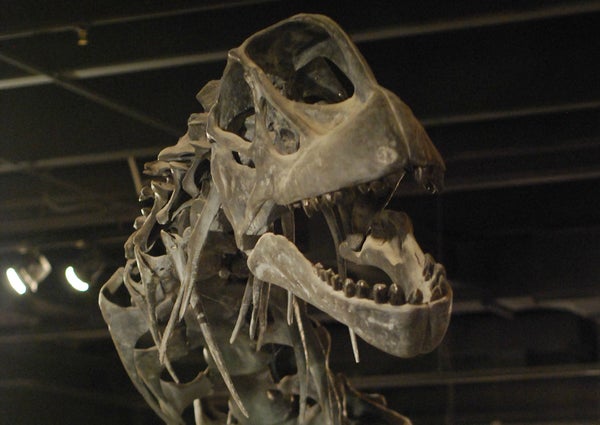
Camarasaurus has always had something of an image problem. While the other sauropods of Late Jurassic time have often been depicted as slender and elegant (think Diplodocus) or towering and impressive (Brachiosaurus, naturally), poor Camarasaurus is usually restored as a stocky dinosaur with a goofy smile of spoon-shaped teeth. I’m uncertain how far a new study by paleontologists Kayleigh Wiersma and Martin Sander is going to improve the sauropod’s image, but, thanks to an exceptional specimen, we’re at least getting a clearer view at how unusual the “chambered lizard” looked compared to its beloved neighbors.
There’s no shortage of Camarasaurus fossils. The hefty herbivore is the most common sauropod in the far-reaching Morrison Formation, represented by everything from fragments to nearly-complete skeletons. But specimen SMA 0002 from Wyoming’s Howe-Stephens Quarry is special. This dinosaur – nicknamed “E.T.” because the first sign of it in the quarry was a single finger bone sticking out of the rock – is represented by a well-preserved, articulated skeleton, including a skull with teeth still in place. Better yet, impressions of soft tissues were found along the jaws, a chance discovery that is altering our image of Camarasaurus.
On the left lower jaw, Wiersma and Sander report, this special Camarasaurus has patches of “dark carbonaceous film” that cover the tooth roots and parts of the tooth crowns. This isn’t the sediment the dinosaur was buried in, the paleontologists suggest, but the remnants of “gingival connective tissue.” In other words, this was a gummy dinosaur.

The skull of "E.T.", showing some preserved remnants of soft tissue. Credit: Wiersma and Sander 2017
In life, Wiersma and Sander propose, Camarasaurus would've had deep, tough gums. The length of exposed tooth roots, wear along the dinosaur’s teeth, and wrinkle patterns on the tooth enamel hint that at least half the dinosaur’s tooth crowns were covered by gums, “with only the tip of the tooth crows protruding from the soft tissue.” But that’s not all.
Paleontologists often find sauropod “dentures.” The technical term is Isolated Tooth Rows, consisting of closely-packed teeth that separated from the jaws, but the colloquial phrase has a bit more charm to it. Whatever you call them, though, why sauropod smiles should become isolated is a mystery. Previous ideas have included bone-eating insects that unintentionally separated tooth rows from skulls and forms of desiccation, seen in beached porpoise carcasses, where shrinkage of soft tissues pop the teeth from their sockets. After examining their exceptional Camarasaurus, though, Wiersma and Sander propose that there was some sort of beak or tough scales outside the dinosaur’s jaw that helped further protect and support the tooth row. If this was the case, then drying after death or some other phenomena could have popped the entire tooth row out of the jaw, creating those strange sets of teeth outside the skull.
Evidence of the external beak has yet to be found, but Wiersma and Sander suggest that it was there on the basis of the dinosaur’s dental details. There are several teeth in E.T.’s lower jaws that are no longer connected to the jaw bone proper but are still preserved in place. This, the paleontologists write, is a sign that there was some sort of soft tissue holding them there, bolstering them and keeping them functional while the replacement teeth below were still developing. On top of that, some kind of thick external support along the jaws could have both provided protections from abrasive plants and created another cutting surface to shear through ferns and conifer branches.
Sadly, Wiersma and Sander did not commission an image of their new Camarasaurus for the paper. But even in our imagination, the dinosaur comes out looking quite different. The permanent, buck-toothed grin is now largely covered over by lip and beak, just the tips of those tooth crowns poking up from the deep gums. The dinosaur’s profile takes on a friendlier appearance rather than the classic awkward, spoon-toothed grin. The sauropod would be worthy of our adoration regardless – it was an essential part of one of the most astonishing ecosystems ever to exist on Earth – but, given that dinosaurs are subject to popularity contests, too, I can’t help but hope this gives Camarasaurus a bit of a boost.
Reference:
Wiersma, K., Sander, P. 2017. The dentition of a well-preserved specimen of Camarasaurus sp: implications for function, tooth replacement, soft part reconstruction, and food intake. Paläontologische Zeitschrift. doi: 10.1007/s12542-016-0332-6
