
This article was published in Scientific American’s former blog network and reflects the views of the author, not necessarily those of Scientific American
Fossil apes are hard to find. That’s thanks, in part, to the places they lived. Hot, humid forests aren’t exactly great places for longstanding preservation. They're spots where bodies are quickly broken down and there’s a constrained number of places where sediment is being laid down to rapidly cover bodies. Still, against overwhelming odds, paleontologists have slowly been adding ancient apes to our family tree, including a baby preserved in the 13 million year old rock of Napudet, Kenya.
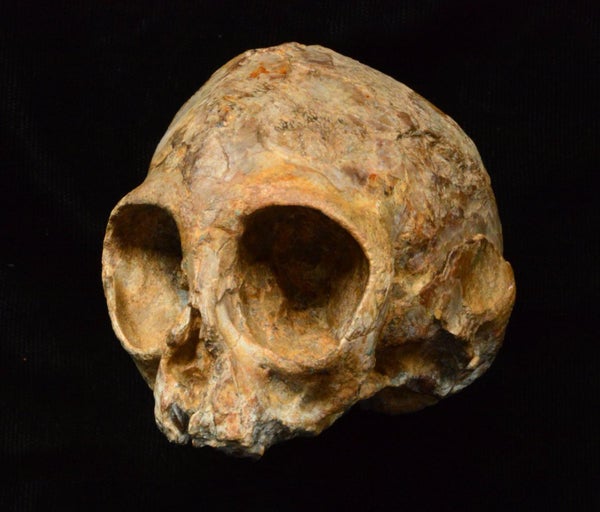
The official label on the Miocene cranium is KNM-NP 59050. But the researchers who found it and carried out the initial study know it as Alesi, from the Turkana word of “ancestor”, immortalized in the species name Nyanzapithecus alesi. It truly is an undeniably cute fossil. Even though vacant, the large, forward-facing eye sockets give the fossil the innocent look that makes puppies and kittens warm our hearts.

Views of Alesi. Credit: Nengo et al 2017
On supporting science journalism
If you're enjoying this article, consider supporting our award-winning journalism by subscribing. By purchasing a subscription you are helping to ensure the future of impactful stories about the discoveries and ideas shaping our world today.
Overall, paleontologist Isaiah Nengo and colleagues write, Alesi looks very much like today’s gibbons. That fits given the age of the fossil and its place in the part of the tree where the catarrhines – or Old World monkeys – were giving off a new branch that would lead to the hominoids, or apes.
All the same, the researchers report, it would be wrong to call Alesi a fossil gibbon. There’s no discrete traits linking the skull to that group. Alesi either represents a more ancient condition inherited by the gibbons or a case of convergent evolution as early apes were getting their feet under them. Either way, given the rarity of prehistoric apes, Alesi will undoubtedly be a touchstone for future studies and have a place among other greats like Lucy and Mrs. Ples in our evolutionary backstory.
Reference:
Nengo, I., Tafforeau, P., Gilbert, C., Fleagle, J., Miller, E., Feibel, C., Feinberg, J., Pugh, K., Berruyer, C., Mana, S., Engle, Z., Spoor, F. 2017. New infant cranium from the African Miocene sheds light on ape evolution. Nature. doi: 10.1038/nature23456
