
This article was published in Scientific American’s former blog network and reflects the views of the author, not necessarily those of Scientific American
Over a thousand years ago, on Madagascar, lived the largest bird of all time. This was not flier. It was a ratite, a flightless bird of the same family as emus and ostriches, belonging to a group appropriately called elephant birds. In a new study that has identified the strutting giant, zoologists James Hansford and Samuel Turvey have called this prodigious bird Vorombe titan.
Vorombe would have been impressive enough on its own. When alive, the researchers estimate, the bird would have weighed over 1,400 pounds. (This led to a rather silly headline from LiveScience that Vorombe “weighed as much as a dinosaur” when, as a bird, Vorombe is by definition a dinosaur.) But Vorombe was only the largest of an entire flock of elephant birds, which Hansford and Turvey surveyed to get a better idea of how diverse these extinct avians really were.
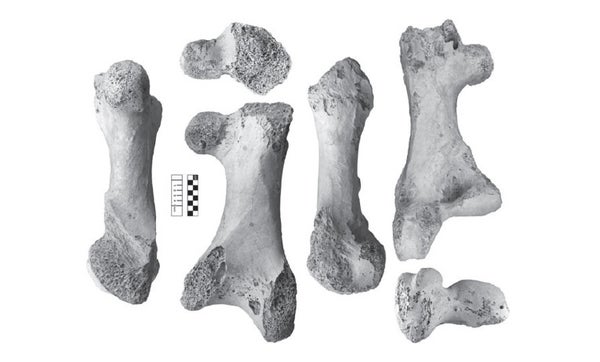
Even though elephant birds have an evolutionary history that potentially stretches as far back as 27 million years, most of what we know about them comes from much more recent times. The last of them went extinct about 1,000 years ago, after the arrival of humans on Madagascar, and the birds were only recognized by naturalists in 1851. And, despite being icons of extinction, Hansford and Turvey point out that relatively little scientific work has been done on the group compared to other giant, recently-extinct birds like moas. To help sort out the elephant bird family tree, then, the zoologists turned to limb bone measurements and comparisons to categorize the different forms of elephant birds that used to roam their island home.
On supporting science journalism
If you're enjoying this article, consider supporting our award-winning journalism by subscribing. By purchasing a subscription you are helping to ensure the future of impactful stories about the discoveries and ideas shaping our world today.
The new framework proposed by Hansford and Turvey recognizes three genera and four species of elephant birds, clustering into three different size categories. There was the small Mullerornis modestus, the two mid-sized species Aepyornis hildebranti and Aepyornis maximus, and the new, giant Vorombe titan. And even though the zoologists note that better dating of elephant bird bones is needed, existing locality information indicates that small, medium, and large elephant birds co-existed in the same habitats to the south, southwest, and center of Madagascar. (An exception is Aepyornis hildebranti, which seemed to prefer more upland environments than the other birds, and there are as yet little-known elephant birds from the north of the island.)
Still, as the researchers themselves state, this is just one more step among many needed to better understand this enormous birds. Elephant birds are still enigmas to us. People undoubtedly saw them. Perhaps people even drove them to extinction. We have the eggshell and bones of the birds, so recent that they’re referred to as “sub-fossil.” From the geologic big picture, they were alive only yesterday yet we know less about them than long-dead monsters like Tyrannosaurus. Vorombe and its relatives loom large in our imaginations, but we still trying to understand where those visions intersect reality.