
This article was published in Scientific American’s former blog network and reflects the views of the author, not necessarily those of Scientific American
Ceratosaurs rarely get the attention they deserve. Sure, there's the bulldog-faced Carnotaurus and Ceratosaurus itself, but for the most part these dinosaurs are treated as the "also rans" of the Jurassic and Cretaceous - present but not as numerous or charismatic as the allosaurs and tyrannosaurs that exceeded them in size and inferred ferocity. That's a shame. Ceratosaurs were disparate as theropods go, ranging from stubby snaggletooths like Masiakasaurus to little herbivores like Limusaurus and knobbly-headed hypercarnivores like Majungasaurus. Each and every one seems weird in its own way, including a member of their family that has stood as an enigma for almost a century.
Elaphrosaurus bambergi isn't a new dinosaur. German paleontologist Werner Janensch named the species back in 1920 from a partial skeleton found in the 154-million-year-old Tendaguru Beds that also yielded such Jurassic stars as the spiky Kentrosaurus and the towering Giraffatitan. At the time Janensch thought Elaphrosaurus to be too strange to belong to any known family, but in the following decades other researchers suggested that it might have been a relative of the ostrich-mimic dinosaurs, a late-surviving cousin of the slender Coelophysis, and, more recently, one of the ceratosaurs.
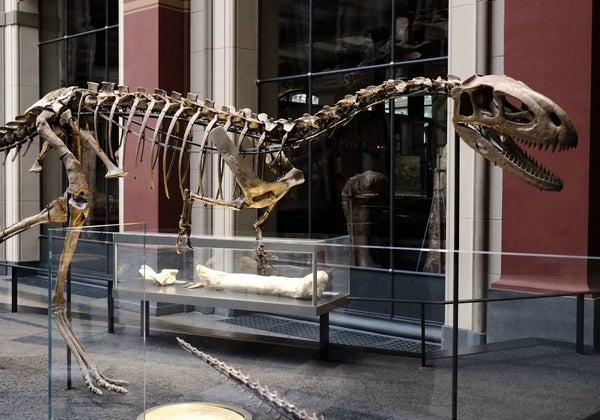
Part of the reason for all the different opinions was the fact that the only known skeleton of Elaphrosaurus was kept under glass at Berlin's Museum für Naturkunde. It's not the best circumstance for gaining a comprehensive anatomical view of a dinosaur. But, recently, a grand renovation of the museum's fossil halls allowed paleontologists Oliver Rauhut and Matt Carrano to take a closer look at the mysterious dinosaur.
While the Elaphrosaurus skeleton is not complete - it's missing the skull, hands, and other parts - enough of it was found to show that this animal had proportions a little different than the typical theropod image embodied by carnivores like Allosaurus and Tyrannosaurus. While Elaphrosaurus had long legs, suggestive of a speedy saurian, the length of the dinosaurs neck and tail gives it something of a low-slung look. Viewed in detail, Rauhut and Carrano report, Elaphrosaurus comes out where other researchers had suggested - within the ceratosaur family tree in a subgroup called noasaurids.
So what does this mean for for Elaphrosaurus lived? That's hard to say without a skull. Elaphrosaurus has traditionally been viewed as a flesh-ripper - check out the skull on the Berlin reconstruction - but in the new family tree the dinosaur is closely-related to both the toothless Limusaurus and the small-prey specialist Masiakasaurus. Elaphrosaurus could have been like either or neither, but, based on the anatomy of the vertebrae, Rauhut and Carrano suggest that this dinosaur just didn't have the neck flexibility to tackle big game. Elaphrosaurus was doing something different, and may have been even stranger than we ever imagined. Someone just needs to find a skull.

The known elements of Elaphrosaurus. From Rauhut and Carrano, 2016.
Fossil Facts
On supporting science journalism
If you're enjoying this article, consider supporting our award-winning journalism by subscribing. By purchasing a subscription you are helping to ensure the future of impactful stories about the discoveries and ideas shaping our world today.
Name: Elaphrosaurus bambergi
Meaning: Elaphrosaurus means "light-footed lizard", while bambergi is a tribute to industrialist Paul Bamberg for funding the expedition that found the dinosaur.
Age: Around 154 million years ago.
Where in the world?: Tanzania.
What sort of critter?: A dinosaur belonging to a theropod line known as the noasaurids.
Size: Around 20 feet long and about 800 lbs.
How much of the creature’s body is known?: A skeleton that includes parts of the backbone, shoulders, hips, forelimbs, and a nearly-complete hindlimb.
References:
Rauhut, O., Carrano, M. 2016. The theropod dinosaur Elaphrosaurus bambergi Janensch, 1920, from the Late Jurassic of Tendaguru, Tanzania. Zoological Journal of the Linnean Society. doi: 10.1111/zoj.12425
