
This article was published in Scientific American’s former blog network and reflects the views of the author, not necessarily those of Scientific American
Caecilians are strange little amphibians. They look more like gooey snakes that frogs, and, due to a sparse fossil record, paleontologists have been confounded by their deep evolutionary backstory. Even though family trees made from molecular data predicted that they've been around for over 270 million years, only two early caecilian fossils have ever turned up, with even the oldest of the two still leaving a 70 million year gap between when they were supposed to have appeared and when the fossils start turning up.
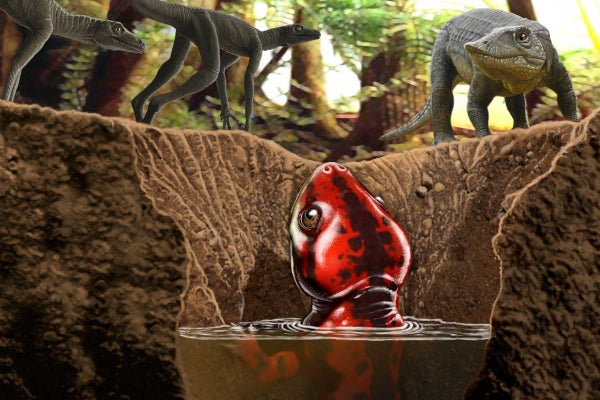
Enter Chinlestegophis. Known from a pair of partial skulls found in Colorado, and described by Jason Pardo and colleagues, this amphibian pushes the fossil record of caecilians back to about 215 million years ago. Unlike its later fossil cousins, the skeleton of Chinlestegophis doesn't look quite as modern, instead have what the researchers call "a mélange" of traits in common with both caecilians and more generalized ancestors. And it's that combination that has little Chinlestegophis changing what paleontologists thought about the where caecilians came from.
When Pardo and and coauthors went about trying to place Chinlestegophis in the wider amphibian family tree - including lineages thought to be totally extinct - they found a surprise. Caecilians were closely related to a group of ancient amphibians called stereopdondyls - bulky, vaguely salamander-like amphibians with toothy jaws that opened like toilet seats. This group was supposed to be totally extinguished in the deep past, but the new study suggests that caecilians are now carrying the stereospondyl banner into our time. What's old is new again.

Skulls of Chinlestegophis. Credit: Pardo et al 2017
Fossil Facts
On supporting science journalism
If you're enjoying this article, consider supporting our award-winning journalism by subscribing. By purchasing a subscription you are helping to ensure the future of impactful stories about the discoveries and ideas shaping our world today.
Name: Chinlestegophis jenkinsi
Meaning: Chinlestegophis translates to "Chinle roofed serpent", while jenkinsi is a tribute to paleontologist Farish Jenkins.
Age: Triassic, about 215 million years old.
Where in the world?: Colorado, USA.
What sort of organism?: An amphibian called a caecilian.
How much of the organism’s is known?: Two partial skulls.
Reference:
Pardo, J., Small, B., Huttenlocker, A. 2017. Stem caecilian from the Triassic of Colorado sheds light on the origins of lissamphibia. PNAS. doi: 10.1073/pnas.1706752114
Previous Paleo Profiles:
The Light-Footed Lizard The Maoming Cat Knight’s Egyptian Bat The La Luna Snake The Rio do Rasto Tooth Bob Weir's Otter Egypt's Canine Beast The Vastan Mine Tapir Pangu's Wing The Dawn Megamouth The Genga Lizard The Micro Lion The Mystery Titanosaur The Echo Hunter The Lo Hueco Titan The Three-Branched Cicada The Monster of Minden The Pig-Footed Bandicoot Hayden's Rattlesnake Demon The Evasive Ostrich Seer The Paradoxical Mega Shark The Tiny Beardogs The Armored Fish King North America's Pangolin The Invisible-Tusked Elephant The Mud Dragon The Spike-Toothed Salmon The Dream Coast Crocodile Buriol's Robber Ozimek's Flyer The Northern Naustoceratopsian The High Arctic Flyer The Tomatillo From the End of the World The Short-Faced Hyena The Mighty Traveler from Egg Mountain Keilhau's Ichthyosaur Mexico's Ancient Horned Face Mauricio Fernández's Plesiosaur New Zealand's Giant Dawn Penguin The Orange Sea Lion Mongolia's Ginkgo Cousin The Geni River Frog Isabel Berry's Dinosaur The Whale Caiman The Moab Lizard Yang Zhongjian's Lizard The Little Anubis The Shuangbai Lizard The Wyvern Dinosaur The "Need Helmet" Dinosaur The Jianianhua Dragon The Liaoning Hunter The Dalian Lizard Crompton's Aleodon
