
This article was published in Scientific American’s former blog network and reflects the views of the author, not necessarily those of Scientific American
Impressive as they are, whales are evolutionary copycats. The great tale of how they went from landlubbers to leviathans had already been played out long before, starting 250 million years ago. Mammals hadn't even evolved by that time, of course, so it was reptiles who were sliding back into the seas.
Just as with whales, the ancestors of ichthyosaurs used to live on land. They explored the ocean during the earliest days of the Triassic and stayed there, truly living up to the name "fish lizard." Some of them even resembled reptilian whales and dolphins, albeit swishing their tails from side-to-side rather than up-and down. Dragging tails turned to propulsive organs and front flippers turned into steering paddles. But what about those back legs? A newly-named ichthyosaur from Svalbard, Norway adds a little more context to the story.
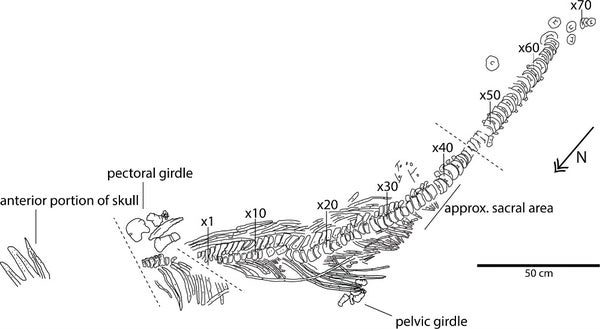
Named by paleontologist Lene Liebe Delsett and colleagues, Keilhauia nui is represented by a partial, articulated skeleton. What makes it remarkable, however, is the fact that this 144 million year old ichthyosaur is preserved with much of its hips. While earlier, Triassic ichthyosaurs are regularly found with complete hips, Jurassic and Cretaceous forms often lack these parts. Keilhauia, along with several other ichthyosaurs found in the same site, help illustrate what was going on with the ichthyosaur pelvis of these full-time ocean swimmers.
Viewed together, Delsett and coauthors write, Keilhauia and other ichthyosaurs found in the fossil rich layers leading across the end of the Jurassic to the earliest Cretaceous show a variety of pelvis sizes and anatomies. There was not a straightforward or rapid reduction in size as seen in whales. Ichthyosaurs, the paleontologists point out, retained their hips and remnants of their hindlinbs throughout their 100-million-year-plus history. The question is why. The answer might have something to do with steering or the way ichthyosaurs might have gripped each other while mating, Delsett and colleagues suggest, but, for now, only the ichthyosaurs would know if paleontologists are on the right track.

An additional ichthyosaur found at Svalbard. Credit: Delsett et al. 2017
Fossil Facts
On supporting science journalism
If you're enjoying this article, consider supporting our award-winning journalism by subscribing. By purchasing a subscription you are helping to ensure the future of impactful stories about the discoveries and ideas shaping our world today.
Name: Keilhauia nui
Meaning: Keilhauia honors pioneering Arctic geologist Baltazar Mathias Keilhau, while nui is after Natur og Undom (Young Friends of the Earth Norway).
Age: Cretaceous, 144 million years ago.
Where in the world?: Svalbard, Norway.
What sort of critter?: An ichthyosaur.
Size: Over 12 feet long.
How much of the organism’s body is known?: An articulated partial skeleton.
Reference:
Delsett, L., Roberts, A., Druckenmiller, P., Hurum, J. 2017. A new opthalmosaurid (Ichthyosauria) from Svalbard, Norway, and evolution of the icthyopterygian pelvic girdle. PLOS ONE. doi: 10.1371/journal.pone.0169971
Previous Paleo Profiles:
The Light-Footed Lizard The Maoming Cat Knight’s Egyptian Bat The La Luna Snake The Rio do Rasto Tooth Bob Weir's Otter Egypt's Canine Beast The Vastan Mine Tapir Pangu's Wing The Dawn Megamouth The Genga Lizard The Micro Lion The Mystery Titanosaur The Echo Hunter The Lo Hueco Titan The Three-Branched Cicada The Monster of Minden The Pig-Footed Bandicoot Hayden's Rattlesnake Demon The Evasive Ostrich Seer The Paradoxical Mega Shark The Tiny Beardogs The Armored Fish King North America's Pangolin The Invisible-Tusked Elephant The Mud Dragon The Spike-Toothed Salmon The Dream Coast Crocodile Buriol's Robber Ozimek's Flyer The Northern Naustoceratopsian The High Arctic Flyer The Tomatillo From the End of the World The Short-Faced Hyena The Mighty Traveler from Egg Mountain
