
This article was published in Scientific American’s former blog network and reflects the views of the author, not necessarily those of Scientific American
Years ago, when I was trying to give myself a crash course in paleo, I had assumed that the varied wonders of the Burgess Shale had already been found. That's the impression I came away from Stephen Jay Gould's Wonderful Life with - the Cambrian oddballs had been assembled, but it was their interpretation that kept shifting. But over the past few years researchers have underscored the fact that there's still an entire menagerie of strange Paleozoic creatures in the Burgess Shale that are only now being recognized. Kootenayscolex barbarensis is the latest to join the club.
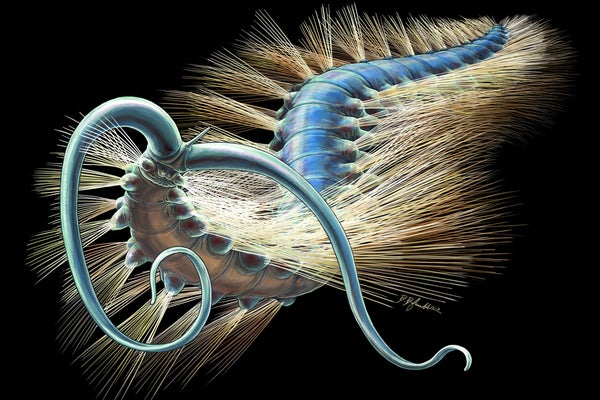
Described by paleontologists Karma Nanglu and Jean-Bernard Caron, Kootenayscolex is one of those Cambrian critters that might not look too out of place if it were still squirming around today. It's an annelid, or segmented worm, that resembles its modern polychaete cousins known as bristleworms. But, as ever, the fossiliferous devil is in the details, and the 508 million-year-old Kootenayscolex bears some unusual traits that set it apart.
Consider the bristles. Kootenayscolex isn't unique for having them, but its their placement that's unusual. In addition to brushes along the side of the body, prominent bristles also stick out around the head and mouth of Kootenayscolex - something not seen before. Combined with studies of living annelids, Nanglu and Caron propose, this might mean that the annelid head is basically a more posterior body segment that was modified, which may say something about the early evolution of annelid bodies. Kootenayscolex and related worms may provide the key to understanding how our modern wrigglers came to be as they are. But there's an even simpler facet to the find. At the very least, that this new worm was discovered at all underscores that the Burgess Shale still has secrets for us.
On supporting science journalism
If you're enjoying this article, consider supporting our award-winning journalism by subscribing. By purchasing a subscription you are helping to ensure the future of impactful stories about the discoveries and ideas shaping our world today.

A lovely specimen of Kootenayscolex barbarensis. Credit: Jean-Bernard Caron Royal Ontario Museum
Name: Kootenayscolex barbarensis
Meaning:Kootenayscolex is a combination of Kootenay - the name of the national park where the fossils were found - and scolex, which is the head portion of annelid worms. The species name barbarensis honors Royal Ontario Museum volunteer Barbara Polk.
Age: Cambrian, about 508 million years ago.
Where in the world?: Marble Canyon, British Columbia.
What sort of organism?: An early polychaete worm.
How much of the organism’s is known?: Over 500 specimens.
Reference:
Nanglu, K. Caron, J. 2018. A new Burgess Shale polychaete and the origin of the annelid head revisited. Current Biology. doi: 10.1016/j.cub.2017.12.019
More Paleo Profiles:
The Light-Footed Lizard The Maoming Cat Knight’s Egyptian Bat The La Luna Snake The Rio do Rasto Tooth Bob Weir's Otter Egypt's Canine Beast The Vastan Mine Tapir Pangu's Wing The Dawn Megamouth The Genga Lizard The Micro Lion The Mystery Titanosaur The Echo Hunter The Lo Hueco Titan The Three-Branched Cicada The Monster of Minden The Pig-Footed Bandicoot Hayden's Rattlesnake Demon The Evasive Ostrich Seer The Paradoxical Mega Shark The Tiny Beardogs The Armored Fish King North America's Pangolin The Invisible-Tusked Elephant The Mud Dragon The Spike-Toothed Salmon The Dream Coast Crocodile Buriol's Robber Ozimek's Flyer The Northern Naustoceratopsian The High Arctic Flyer The Tomatillo From the End of the World The Short-Faced Hyena The Mighty Traveler from Egg Mountain Keilhau's Ichthyosaur Mexico's Ancient Horned Face Mauricio Fernández's Plesiosaur New Zealand's Giant Dawn Penguin The Orange Sea Lion Mongolia's Ginkgo Cousin The Geni River Frog Isabel Berry's Dinosaur The Whale Caiman The Moab Lizard Yang Zhongjian's Lizard The Little Anubis The Shuangbai Lizard The Wyvern Dinosaur The "Need Helmet" Dinosaur The Jianianhua Dragon The Liaoning Hunter The Dalian Lizard Crompton's Aleodon Jenkins' Amphibian Serpent From the Chinle The Large Ancestor Lizard The Crown Tooth Currie's Alberta Hunter The Elephant Bird Mimic The Crested Thief The Hiding Hunter The Horned Lizard The Silk Bird The Sieve-Toothed Plesiosaur The Defenseless Snout Burian's Lizard The Small Whaitsiid The Beautiful Bird The Fierce Cat The Older One From Melksham The King of the Miocene Iberian Giraffes Miera's Lizard The Traveling Sloth The Sand Whale Shouten's Marsupial Lion The Rhaetian Lizard The Mountain Dolphin The Bryant's Shark The Rainbow Dinosaur
