
This article was published in Scientific American’s former blog network and reflects the views of the author, not necessarily those of Scientific American
Mass extinctions are terrible events. Such losses to life on Earth can be counted and cataloged, but are so vast are in scale that the devastation can hardly be understood. But life has always bounced back. Take the catastrophe that closed the Cretaceous 66 million years ago. We lost the non-avian dinosaurs, pterosaurs, mosasaurs, and other magnificent creatures, but, in the aftermath, the survivors flourished. Among those that became pioneers of the new Cenozoic world were penguins.
Penguins are a very ancient form of bird. The very first of their kind had evolved by 61 million years ago. Rather than embodying a straight-line march between archaic forms and penguins of modern aspect, though, paleontologists are finding that early penguins were both diverse and disparate. And among their numbers was a giant.
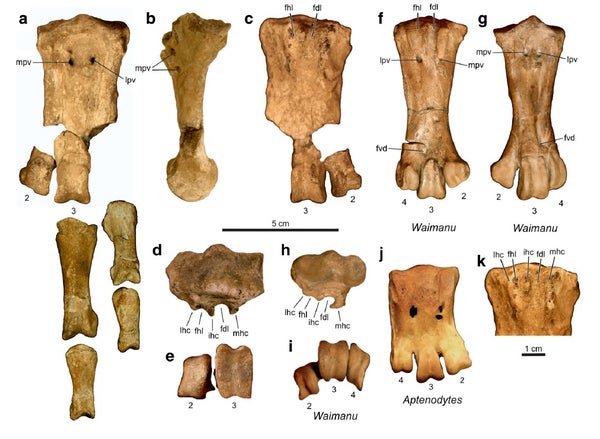
The latest early penguin to be announced has no official name yet. Paleontologist Gerald Mayr and colleagues refer to it by its catalog number, CM 2016.158.1. But this animal's foot bones, found in the 61 million year old greensand of New Zealand, have helped alter the picture of what happened as penguin evolution took off in the early chapters of the Cenozoic.
The fossils were found about 36 feet above the spot where Waimanu manneringi, the oldest known penguin, was discovered. The bones of CM 2016.158.1 appear to be from a larger animal, though, rivaling those of the huge penguin Anthropornis in size. This was a penguin that could have looked you straight in the eye. At the very least, Mayr and coauthors wrote, this indicates penguins evolved to giant sizes very early in their history and huge penguin species persisted for the next 30 million years.
But there's something else. Even though CM 2016.158.1 was found so close to Waimanu, the details of its bones indicate that it was more derived. In other words, it's a sign that Waimanu represents a much more archaic form that lived near in time or at the same time as penguins that were departing further from their ancestral stock by 61 million years ago. In the context of other recent finds, Mayr and coauthors write, this might mean that penguins actually originated in the Late Cretaceous and underwent a much earlier diversification than previously thought. We're only just starting to understand the dawn of the penguins.

A family tree of penguins. Credit: Mayr et al. 2017
Fossil Facts
On supporting science journalism
If you're enjoying this article, consider supporting our award-winning journalism by subscribing. By purchasing a subscription you are helping to ensure the future of impactful stories about the discoveries and ideas shaping our world today.
Name: There is no official name yet, but the fossils carry the catalog number CM 2016.158.1.
Age: Paleocene, 61 million years ago.
Where in the world?: Canterbury Province, New Zealand.
What sort of critter?: An early penguin.
Size: Larger than today's emperor penguin.
How much of the organism’s body is known?: A partial left foot.
Reference:
Mayr, G. De Pietri, V., Scofield, P. 2017. A new fossil from the mid-Paleocene of New Zealand reveals an unexpected diversity of world's oldest penguins. Science of Nature. doi: 10.1007/s00114-017-1441-0
Previous Paleo Profiles:
The Light-Footed Lizard The Maoming Cat Knight’s Egyptian Bat The La Luna Snake The Rio do Rasto Tooth Bob Weir's Otter Egypt's Canine Beast The Vastan Mine Tapir Pangu's Wing The Dawn Megamouth The Genga Lizard The Micro Lion The Mystery Titanosaur The Echo Hunter The Lo Hueco Titan The Three-Branched Cicada The Monster of Minden The Pig-Footed Bandicoot Hayden's Rattlesnake Demon The Evasive Ostrich Seer The Paradoxical Mega Shark The Tiny Beardogs The Armored Fish King North America's Pangolin The Invisible-Tusked Elephant The Mud Dragon The Spike-Toothed Salmon The Dream Coast Crocodile Buriol's Robber Ozimek's Flyer The Northern Naustoceratopsian The High Arctic Flyer The Tomatillo From the End of the World The Short-Faced Hyena The Mighty Traveler from Egg Mountain Keilhau's Ichthyosaur Mexico's Ancient Horned Face Mauricio Fernández's Plesiosaur
