
This article was published in Scientific American’s former blog network and reflects the views of the author, not necessarily those of Scientific American
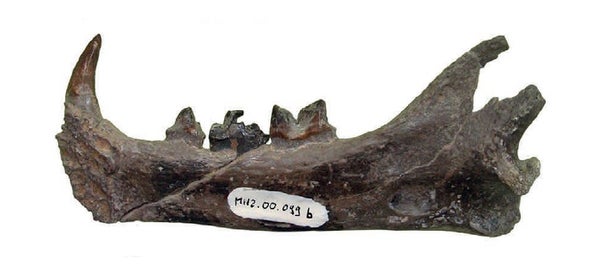
Fossil humans cast a long shadow over the past six million years of Africa's fossil record. The public could be forgiven for thinking that paleontologists haven't found much else other than the bones of early hominins in the Miocene, Pliocene, and Pleistocene rocks of the continent, with a smattering of more-or-less elephants, pretty-much-lions, and other familiar animals in the background. (Read Evolving Eden for a remedy to this.) Still, despite the imbalance in how such finds are integrated and communicated into the larger picture of life's history, the search for our ancient relatives has yielded new, nonhuman fossil species that we might have otherwise missed. The latest in this select group is Tchadailurus adei, a sabercat recovered from a site made famous by a controversial fossil ape.
The 7 million-year-old strata of Toros Menalla, Chad were made famous by the discovery of Sahelanthropus - a fossil hominid that may or may not be close to the origin of our own human lineage. But Sahelanthropus wasn't the only beast found here. Paleontologists working the site also recovered parts of many other mammals - including up to 23 different species of carnivorans - and Tchadailurus adds another to the faunal list.
Tchadailurus wasn't very large. Paleontologist Louis de Bonis and colleagues estimate that it was about the size of a lynx. In fact, it was even small compared to the seven other cat species found at Toros Menalla - the largest of which was about the size of the lion. And this is a little strange. Eight species of cat, found together, seems a little high compared to faunas found elsewhere in the latter part of the Cenozoic.
On supporting science journalism
If you're enjoying this article, consider supporting our award-winning journalism by subscribing. By purchasing a subscription you are helping to ensure the future of impactful stories about the discoveries and ideas shaping our world today.
There's more than one possible explanation for such a wealth of fossil felines. It's possible, de Bonis and colleagues write, that Toros Menalla "indicates certainly a favourable environment for this group of meat eater predators." Back in the Miocene, this place could have offered such a rich and varied environment that eight different cat species could have all carved out their own living. Then again, we only know that these cats were found in the same deposits. We know about their burial, in other words, but not whether they really lived shoulder-to-shoulder at the exact same time or represent habitat shifts, species that wandered in from elsewhere, or other quirks of life that could have upped the count in the fossil graveyard. Whatever the case, however, Toros Menalla became a treasure trove of Miocene meat-eaters, offering a look at an as yet little-known time in carnivoran history.

Limb elements of Tchadailurus. Credit: de Bonis et al 2018
Name: Tchadailurus adei
Meaning: Tchadailurus means "Chad cat", and adei means small in the local Goran language where the fossil was found.
Age: Miocene, about 7 million years ago.
Where in the world?: Toros Menalla, Chad.
What sort of organism?: A machairodont, or saber-toothed cat.
How much of the organism’s is known?: Parts of a skull and a partial skeleton.
Reference:
More Paleo Profiles: de Bonis, L., Peigne, S., Mackaye, H., Likius, A., Vignaud, P., Brunet, M. 2018. New sabre toothed Felidae (Carnivora, Mammalia) in the hominid-bearing sites of Toros Menalla (late Miocene, Chad). Geodiversitas. doi: 10.5252/geodiversitas2018v40a3
The Light-Footed Lizard The Maoming Cat Knight’s Egyptian Bat The La Luna Snake The Rio do Rasto Tooth Bob Weir's Otter Egypt's Canine Beast The Vastan Mine Tapir Pangu's Wing The Dawn Megamouth The Genga Lizard The Micro Lion The Mystery Titanosaur The Echo Hunter The Lo Hueco Titan The Three-Branched Cicada The Monster of Minden The Pig-Footed Bandicoot Hayden's Rattlesnake Demon The Evasive Ostrich Seer The Paradoxical Mega Shark The Tiny Beardogs The Armored Fish King North America's Pangolin The Invisible-Tusked Elephant The Mud Dragon The Spike-Toothed Salmon The Dream Coast Crocodile Buriol's Robber Ozimek's Flyer The Northern Naustoceratopsian The High Arctic Flyer The Tomatillo From the End of the World The Short-Faced Hyena The Mighty Traveler from Egg Mountain Keilhau's Ichthyosaur Mexico's Ancient Horned Face Mauricio Fernández's Plesiosaur New Zealand's Giant Dawn Penguin The Orange Sea Lion Mongolia's Ginkgo Cousin The Geni River Frog Isabel Berry's Dinosaur The Whale Caiman The Moab Lizard Yang Zhongjian's Lizard The Little Anubis The Shuangbai Lizard The Wyvern Dinosaur The "Need Helmet" Dinosaur The Jianianhua Dragon The Liaoning Hunter The Dalian Lizard Crompton's Aleodon Jenkins' Amphibian Serpent From the Chinle The Large Ancestor Lizard The Crown Tooth Currie's Alberta Hunter The Elephant Bird Mimic The Crested Thief The Hiding Hunter The Horned Lizard The Silk Bird The Sieve-Toothed Plesiosaur The Defenseless Snout Burian's Lizard The Small Whaitsiid The Beautiful Bird The Fierce Cat The Older One From Melksham The King of the Miocene Iberian Giraffes Miera's Lizard The Traveling Sloth The Sand Whale Shouten's Marsupial Lion The Rhaetian Lizard The Mountain Dolphin The Bryant's Shark The Rainbow Dinosaur Kootenay Bristle Worm The Masaoura Lizard The Chimera Spider
