
This article was published in Scientific American’s former blog network and reflects the views of the author, not necessarily those of Scientific American
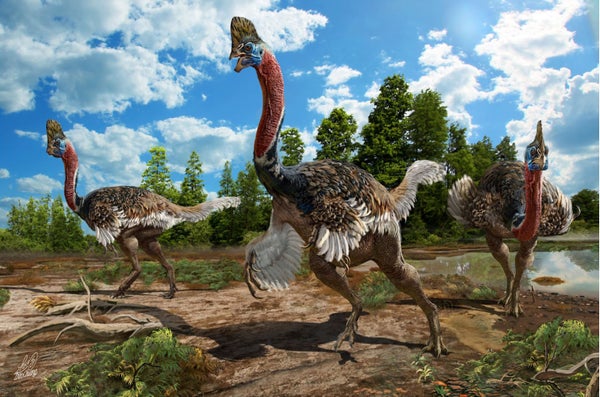
Corythoraptor means "crested thief." It's a fitting name for a dinosaur with a high-rise dome jutting up from its skull, and, had it not lived tens of millions of years ago, it might be accused of stealing another dinosaur's look.
The new dinosaur, described by paleontologist Junchang Lü and colleagues, is known from a near-complete skeleton uncovered in Ganzhou, China. It was one of the oviraptorosaurs - the bird-like "egg thieves" - and isn't the only one to be found in this area. Corythoraptor brings the tally of oviraptorosaurs from this place and time to seven, and is primarily told apart from its fossilized neighbors by its remarkable crest.
The headgear of Corythoraptor resembles that of a cassowary, the flightless bird of Australia and New Guinea famous for its prominent headgear and terrifying talons. The resemblance is mostly superficial - the bone structure inside the oviraptorosaur's helmet differs from its modern relative - but it's hard not to see at least a passing ornamental resemblance. And, as ever, we're left to ask "Why?"
Lü and colleagues offer a few possibilities. The helmet could have helped Corythoraptor regulate its body temperature, spaces inside the crest helping to dissipate heat. Then again, perhaps the structure could have helped the dinosaur make low-frequency calls like cassowaries do today. And, of course, the crest is a visual fashion statement. We're left to scratch our own heads over what these dinosaurs were able to immediately recognize when they saw each other back in the Cretaceous.

The head of Corythoraptor. Credit: Lü et al 2017
Fossil Facts
On supporting science journalism
If you're enjoying this article, consider supporting our award-winning journalism by subscribing. By purchasing a subscription you are helping to ensure the future of impactful stories about the discoveries and ideas shaping our world today.
Name: Corythoraptor jacobsi
Meaning: Corythoraptor means "crested thief", while jacobsi is in honor of paleontologist Louis Jacobs.
Age: Cretaceous, around 72 million years old.
Where in the world?: Ganzhou City, China.
What sort of organism?: An oviraptorosaurian dinosaur.
How much of the organism’s is known?: A nearly-complete skeleton.
Reference:
Lü, J., Li, G., Kundrát, M., Lee, Y., Sun, Z., Kobayashi, Y., Shen, C., Teng, F., Liu, H. 2017. High diversity of the Ganzhou oviraptorid fauna increased by a new "cassowary-like" crested species. Scientific Reports. doi: 10.1038/s41598-017-05016-6
Previous Paleo Profiles:
The Light-Footed Lizard The Maoming Cat Knight’s Egyptian Bat The La Luna Snake The Rio do Rasto Tooth Bob Weir's Otter Egypt's Canine Beast The Vastan Mine Tapir Pangu's Wing The Dawn Megamouth The Genga Lizard The Micro Lion The Mystery Titanosaur The Echo Hunter The Lo Hueco Titan The Three-Branched Cicada The Monster of Minden The Pig-Footed Bandicoot Hayden's Rattlesnake Demon The Evasive Ostrich Seer The Paradoxical Mega Shark The Tiny Beardogs The Armored Fish King North America's Pangolin The Invisible-Tusked Elephant The Mud Dragon The Spike-Toothed Salmon The Dream Coast Crocodile Buriol's Robber Ozimek's Flyer The Northern Naustoceratopsian The High Arctic Flyer The Tomatillo From the End of the World The Short-Faced Hyena The Mighty Traveler from Egg Mountain Keilhau's Ichthyosaur Mexico's Ancient Horned Face Mauricio Fernández's Plesiosaur New Zealand's Giant Dawn Penguin The Orange Sea Lion Mongolia's Ginkgo Cousin The Geni River Frog Isabel Berry's Dinosaur The Whale Caiman The Moab Lizard Yang Zhongjian's Lizard The Little Anubis The Shuangbai Lizard The Wyvern Dinosaur The "Need Helmet" Dinosaur The Jianianhua Dragon The Liaoning Hunter The Dalian Lizard Crompton's Aleodon Jenkins' Amphibian Serpent From the Chinle The Large Ancestor Lizard The Crown Tooth Currie's Alberta Hunter The Elephant Bird Mimic
