
This article was published in Scientific American’s former blog network and reflects the views of the author, not necessarily those of Scientific American
It's difficult to overstate the weirdness of the Triassic. Even though this time held the first glimmerings of familiar life - the ancestors of birds and crocodiles, the first mammals, and more - the evolutionary rebound from the world's worst mass extinction spun off a fantastic array of creatures unlike any seen before or since. Among them was a marine reptile recently uncovered from the 245-232 million year old rock of China.
Paleontologist Chun Li and colleagues have named the animal Litorosuchus somnii. Explaining exactly what this marine reptile was, however, requires a bit of a deep dive into the reptile family tree.
Think of a bird perched of a bird perched on the back of a crocodile. This pair represents the two living groups of archosaurs, or ruling reptiles - a family that also includes the non-avian dinosaurs, pterosaurs, and their closest relatives. Pull the view back a little further and the entire archosaur group is nested within an even broader family called the archosauriforms, which themselves are part of a group called archosauromorphs (Systematic paleontologists get no originality points for these titles.) So within this picture, Litorosuchus comes out as an archosauriform, or a cousin of the creatures that would later give rise to the more famous archosaurs we love so much.
But enough about that for a moment. Nothing fires the paleontological imagination like trying to figure out how these lost species lived. On that point, Li and coauthors point to where Litorosuchus was entombed and the anatomy of its lovely skeleton.
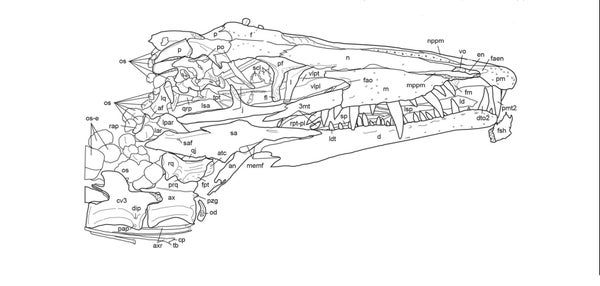
Litorosuchus was buried in marine sediments. By itself, this says more about death than life. Even terrestrial species can be buried at sea in the right circumstances, such as a storm washing a body out to sea. But the osteology of Litorosuchus suggests that this "coast crocodile" was true to its name. The reptile's nose is oriented towards the top of the snout, its tail is deep and would've been useful for side-to-side propulsion, and skin impressions found with the fossil show Litorosuchus had webbed feet in life. Exactly how much time Litorosuchus spent in the water is unknown, but it was clearly a competent swimmer.
Alone, Litorosuchus might stand out as an armored oddity. Placed within the context of its family, however, the newly-named creature speaks to the vibrancy of reptilian evolution in the early days of the Triassic. The Age of Reptiles had just started, with archosauriforms rapidly evolving to create new niches for themselves on the land, in the sea, and, eventually, in the air. Litorosuchus was an early portent of the tens of millions of years of saurian dominance that were to come.
On supporting science journalism
If you're enjoying this article, consider supporting our award-winning journalism by subscribing. By purchasing a subscription you are helping to ensure the future of impactful stories about the discoveries and ideas shaping our world today.

The skeleton of Litorosuchus somnii. Credit: Li et al. 2016
Fossil Facts
Name: Litorosuchus somnii
Meaning: Litorosuchus means "coast crocodile", in reference to the reptile's habitat and crocodile-like appearance. The species name somnii, the paper says, is a "reference to a dream that first author (Li) had the day after he searched for a name for the animal, in which he saw an archosauriform wandering on the beach."
Age: Triassic, 245-232 million years ago.
Where in the world?: Yunnan, China.
What sort of critter?: An archosauriform, or a relative of the group of "ruling reptiles" that includes crocodiles, dinosaurs, and pterosaurs.
Size: About seven feet long.
How much of the creature’s body is known?: A nearly-complete articulated skeleton.
Reference:
Li, C., Wu, X., Zhao, L., Nesbitt, S., Stocker, M., Wang, L. 2016. A new armored archosauriform (Diapsida: Archosauromorpha) from the marine Middle Triassic of China, with implications for the diverse life styles of archosauriforms prior to the diversification of Archosauria. The Science of Nature. doi: 10.1007/s00114-016-1418-4
Previous Paleo Profiles:
The Light-Footed Lizard The Maoming Cat Knight’s Egyptian Bat The La Luna Snake The Rio do Rasto Tooth Bob Weir's Otter Egypt's Canine Beast The Vastan Mine Tapir Pangu's Wing The Dawn Megamouth The Genga Lizard The Micro Lion The Mystery Titanosaur The Echo Hunter The Lo Hueco Titan The Three-Branched Cicada The Monster of Minden The Pig-Footed Bandicoot Hayden's Rattlesnake Demon The Evasive Ostrich Seer The Paradoxical Mega Shark The Tiny Beardogs The Armored Fish King North America's Pangolin The Invisible-Tusked Elephant The Mud Dragon The Spike-Toothed Salmon
