
This article was published in Scientific American’s former blog network and reflects the views of the author, not necessarily those of Scientific American
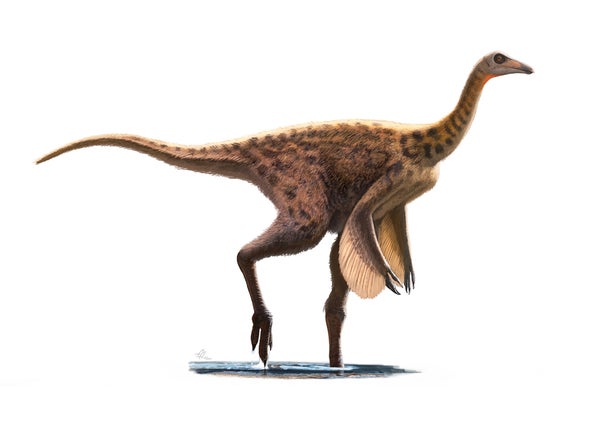
Dinosaurs are excellent at hiding. They're difficult enough to find while tromping around the world's fossil exposures, sometimes little more than a pile of crumbled bone shards alerting you to their presence. Even collected and hauled back to museums, they can be elusive. Consider, for example, Rativates evadens - a new dinosaurs that went under an alias for 80 years.
Paleontologist Brad McFeeters and colleagues tell the tale in their new paper describing the 76 million year old ostrich mimic. Back in 1934 the famous fossil collector Levi Sternberg excavated the partial skeleton of one of these bird-like dinosaurs from the area of what is now Alberta's Dinosaur Provincial Park. There was part of the skull, the hips, a leg and part of another, as well as some tail vertebrae, but not much else. The skeleton was labeled as Struthiomimus altus - a species described in 1917 - and so the new partial skeleton sat in the Royal Ontario Museum collections for the next eight decades under that name.
Once McFeeters and coauthors had a look, though, they saw that Sternberg's fossil was something new. Details of the skull, tail, hip, and foot differ significantly from Struthiomimus, which lived in the same area around the same time. And while this first Rativates was not full-grown when it died, it was close enough to adulthood that McFeeters and colleagues conclude that this dinosaur was only about half the size of its similar neighbor. There may have been two ostrich mimics of different sizes trodding around the same habitats, and this raises the question of whether there may be more as-yet-unidentified ostrich mimics to be found in other levels of the super-productive Dinosaur Provincial Park badlands.

The known elements of Rativates. Credit: McFeeters et al. 2016
Fossil Facts
On supporting science journalism
If you're enjoying this article, consider supporting our award-winning journalism by subscribing. By purchasing a subscription you are helping to ensure the future of impactful stories about the discoveries and ideas shaping our world today.
Name: Rativates evadens
Meaning: Rativates translates to "ratite foreteller", referring to the existence of this ostrich-like dinosaur long before the distantly ostriches and emus evolved, while evadens has a double meaning - the dinosaur's speedy, evasive look as well as the fact that it took 80 years to realize that the dinosaur is new to science.
Age: Cretaceous, about 76 million years old.
Where in the world?: Dinosaur Provincial Park, Canada.
What sort of critter?: An ornithomimid - or "bird mimic" - dinosaur.
Size: About 11 feet long.
How much of the creature’s body is known?: Elements of the skull, a complete left leg, a partial right leg, the hips, and tail vertebrae.
Reference:
McFeeters, B., Ryan, M., Schröder-Adams, C., Cullen, T. 2016. A new ornithomimid theropod from the Dinosaur Park Formation of Alberta, Canada. Journal of Vertebrate Paleontology. doi: 10.1080/02724634.2016.1221415
Previous Paleo Profiles:
The Light-Footed Lizard The Maoming Cat Knight’s Egyptian Bat The La Luna Snake The Rio do Rasto Tooth Bob Weir's Otter Egypt's Canine Beast The Vastan Mine Tapir Pangu's Wing The Dawn Megamouth The Genga Lizard The Micro Lion The Mystery Titanosaur The Echo Hunter The Lo Hueco Titan The Three-Branched Cicada The Monster of Minden The Pig-Footed Bandicoot Hayden's Rattlesnake Demon
