
This article was published in Scientific American’s former blog network and reflects the views of the author, not necessarily those of Scientific American
Paleontology takes patience. Even though we live during a time of frenetic fossil activity, the process of finding, excavating, preparing, studying, and describing previously-unknown creatures from Deep Time often takes years. And that's just when things go smoothly. Sometimes extinct species get hung up in scientific limbo, waiting even longer to receive their names. That's what happened to Gengasaurus nicosiai.
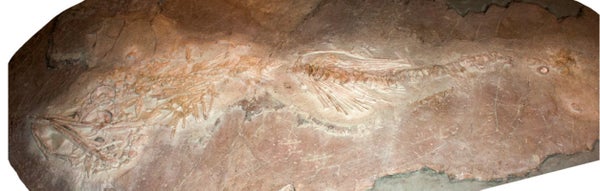
Named for the Italian town where it was found and the paleontologist who prepared the nearly-complete skeleton, Gengasaurus nicosiai was a big-eyed ichthyosaur that swooped through Jurassic seas around 152 million years ago. Its body was found in 1976, one of the most complete "fish lizards" ever found in Italy, but, as paleontologist Ilaria Paparella and coauthors explain in their paper describing the seagoing reptile, the fossil was forgotten about for two decades before expert Umberto Nicosia set about cleaning up the old bones. Another twenty years later, Paparella have recognized "L’Ittiosauro di Genga" as something new to science.
Gengasaurus is one of the ophthalmosauid icthyosaurs. This is a specific group of the shark-like marine reptiles that was widespread through Late Jurassic oceans. And in addition to upping the ichthyosaur count by one, the relationships of Gengasaurus to other ichthyosaurs underscores longstanding questions about how these marine reptiles moved around the planet.
Ichthyosaurs like Gengasaurus have often thought to be fast-swimming, migratory animals, Paparella and coauthors write, but the emerging picture is that many ichthyosaur species have narrow geographic ranges. Rather than being global swimmers, many Late Jurassic ichthyosaur species may have patrolled smaller areas, evolutionary convergence creating a false image of global travelers. The full story of the Jurassic seas has yet to be drawn from the reptiles who called the ancient waters home.

The skull of Gengasaurus, labeled. Credit: Paparella et al. 2016
On supporting science journalism
If you're enjoying this article, consider supporting our award-winning journalism by subscribing. By purchasing a subscription you are helping to ensure the future of impactful stories about the discoveries and ideas shaping our world today.
Fossil Facts
Name: Gengasaurus nicosiai
Meaning: Gengasaurus means "Genga lizard", after the town where the fossil was found, while nicosiai honors Italian paleontologist Umberto Nicosia.
Age: Jurassic, around 152 million years old.
Where in the world?: Camponocecchio, Italy.
What sort of critter?: An ichthyosaur belonging to a big-eyed group called ophthalmosaurids.
Size: Over eight feet long.
How much of the creature’s body is known?: A nearly-complete skeleton of one individual.
Reference:
Paparella, I., Maxwell, E., Cipriani, A., Roncacè, S., Caldwell, M. 2016. The first ophthalmosaurid ichthyosaur from the Upper Jurassic of the Umbrian–Marchean Apennines (Marche, Central Italy). Geological Magazine. doi: 10.1017/S0016756816000455
Previous Paleo Profiles:
The Light-Footed Lizard The Maoming Cat Knight’s Egyptian Bat The La Luna Snake The Rio do Rasto Tooth Bob Weir's Otter Egypt's Canine Beast The Vastan Mine Tapir Pangu's Wing The Dawn Megamouth
