
This article was published in Scientific American’s former blog network and reflects the views of the author, not necessarily those of Scientific American
Dinosaurs are spotlight stealers. It's not as if we try to stop them. The entire Triassic, Jurassic, Cretaceous span of the Mesozoic is often called the Age of Dinosaurs, as if all other forms of life were B-listers or below. (And I admit I've done this as much as anyone.) But there is no world of dinosaurs without the various other species that existed during that time, including a little frog represented by a dozen lovely specimens.
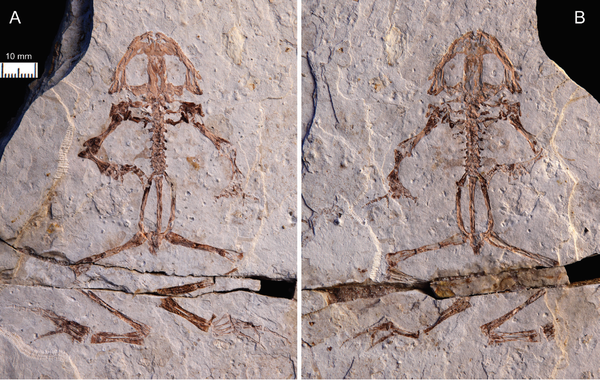
Paleontologists Ke-Qin Gao and Jianye Chen have named the amphibian Genibatrachus basoshanensis. The roughly 125 million year old fossils found in Inner Mongolia look like X-ray views of frogs pinned to stone dissection boards. Looked at in detail, however, Ke-Qin and Jianye point out that Genibatrachus shows a series of features that associate it with other fossil frogs previously discovered in Spain and Brazil.
Among the many, many branches of the frog family tree - there are over 6,600 species alive today - Genibatrachus comes out as an archaic relative of frogs called pipanurans, a major group that includes everything from Surinam toads to poison dart frogs. More than that, Ke-Qin and Jianye write, the details of the fossil's frog spine, ribs, and hips add more detail to the subtle changes these amphibians went through between the Cretaceous and today. Not as imposing as a titanosaur, surely, but importance is not a matter of size alone.

Additional skeletons of Genibatrachus. Credit: Ke-Qin and Jianye 2017
Fossil Facts
On supporting science journalism
If you're enjoying this article, consider supporting our award-winning journalism by subscribing. By purchasing a subscription you are helping to ensure the future of impactful stories about the discoveries and ideas shaping our world today.
Name: Genibatrachus baoshanensis
Meaning: Genibatrachus means "the Geni River frog", while baoshanensis is a reference to the town of Baoshan near where the fossils were found.
Age: Cretaceous, around 125 million years ago.
Where in the world?: Inner Mongolia, China.
What sort of organism?: A frog.
Size: About 2.7 inches long for adults.
How much of the organism’s is known?: A dozen skeletons.
Reference:
Ke-Qin, G., Jianye, C. 2017. A new crown-group frog (Amphibia, Anura) from the early Cretaceous of northeastern Inner Mongolia, China. American Museum Novitates. 3876: 1-39.
Previous Paleo Profiles:
The Light-Footed Lizard The Maoming Cat Knight’s Egyptian Bat The La Luna Snake The Rio do Rasto Tooth Bob Weir's Otter Egypt's Canine Beast The Vastan Mine Tapir Pangu's Wing The Dawn Megamouth The Genga Lizard The Micro Lion The Mystery Titanosaur The Echo Hunter The Lo Hueco Titan The Three-Branched Cicada The Monster of Minden The Pig-Footed Bandicoot Hayden's Rattlesnake Demon The Evasive Ostrich Seer The Paradoxical Mega Shark The Tiny Beardogs The Armored Fish King North America's Pangolin The Invisible-Tusked Elephant The Mud Dragon The Spike-Toothed Salmon The Dream Coast Crocodile Buriol's Robber Ozimek's Flyer The Northern Naustoceratopsian The High Arctic Flyer The Tomatillo From the End of the World The Short-Faced Hyena The Mighty Traveler from Egg Mountain Keilhau's Ichthyosaur Mexico's Ancient Horned Face Mauricio Fernández's Plesiosaur New Zealand's Giant Dawn Penguin The Orange Sea Lion Mongolia's Ginkgo Cousin
