
This article was published in Scientific American’s former blog network and reflects the views of the author, not necessarily those of Scientific American
For as long as I can recall, ankylosaurs have been referred to as "living tanks." I love that turn of phrase. Even though the purpose of all their ornate osteoderms has been debated, it's hard to look at something like Ankylosaurus and not think of the bulky herbivore trundling along and making rumbling noises like an M1 Abrams.
The tale of the ankylosaurs goes well back into the Jurassic. In fact, extensively-armored species lived shoulder-to-shoulder with the likes of Stegosaurus around 150 million years ago. Ornamental osteoderms were in fashion for a long time. But paleontologists are still trying to pick apart how the classic ankylosaur look came to be, especially the smash-and-bash tail club of the Cretaceous ankylosaurids. A newly-named dinosaur from China adds new evidence to that line of investigation.
Named Jinyunpelta by paleontologist Wenjie Zheng and colleagues, the dinosaur currently holds the distinction of being the best-preserved ankylosaurid yet found in southern China. But three other facets of this fossil make it special - its relationship to other ankylosaurs, its age, and its tail club.
In the dinosaur family tree, Zheng and coauthors write, Jinyunpelta is an ankylosaurine. That is, in the broader family of ankylosaurs, and within an even more narrowed subset called ankylosaurids, Jinyunpelta belonged to the heavily-armored, club-wielding subgroup called ankylosaurines that also included the likes of Pinacosaurus and even Ankylosaurus itself. But Jinyunpelta rests at near the base of this group, and is about 100 million years old, making it the oldest known ankylosaurine with a tail club.
This helps narrow the timeline for when armored dinosaurs evolved distinctive knobs at the end of their tails. The club is well-developed in Jinyunpelta, the researchers report, already possessing specialized, V-shaped vertebrae and associated ossified tendons to support the weight of the large lump of bone on the end. This means that the earlier stages of ankylosaur club evolution must have occurred sometime prior to 100 million years ago, and will no doubt have paleontologists searching for additional evidence of how these dinosaurs became so hardcore.
On supporting science journalism
If you're enjoying this article, consider supporting our award-winning journalism by subscribing. By purchasing a subscription you are helping to ensure the future of impactful stories about the discoveries and ideas shaping our world today.

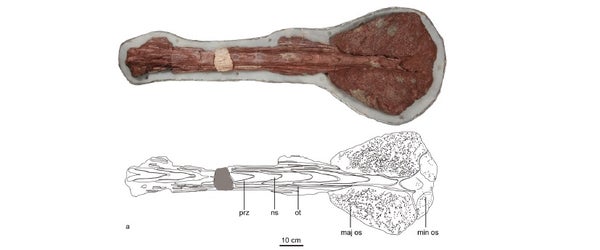
The skull of Jinyunpelta as seen from the top and bottom. Credit: Zheng et al 2018
Name: Jinyungpelta sinensis
Meaning: Jinyunpelta means "Jinyun sheild", after the county where the dinosaur was found and its armored coat, while sinensis refers to China.
Age: Cretaceous, around 100 million years old.
Where in the world?: Zhejiang Province, China.
What sort of organism?: An ankylosaur.
How much of the organism’s is known?: Two partial skeletons, including a skull.
Reference:
Zheng, W., Jin, X., Azuma, Y., Wang, Q., Miyata, K., Xu, X. 2018. The most basal ankylosaurine dinosaur from the Albian-Cenomanian of China, with implications for the evolution of the tail club. Scientific Reports. doi: 10.1038/s41598-018-21924-7
More Paleo Profiles:
The Light-Footed Lizard The Maoming Cat Knight’s Egyptian Bat The La Luna Snake The Rio do Rasto Tooth Bob Weir's Otter Egypt's Canine Beast The Vastan Mine Tapir Pangu's Wing The Dawn Megamouth The Genga Lizard The Micro Lion The Mystery Titanosaur The Echo Hunter The Lo Hueco Titan The Three-Branched Cicada The Monster of Minden The Pig-Footed Bandicoot Hayden's Rattlesnake Demon The Evasive Ostrich Seer The Paradoxical Mega Shark The Tiny Beardogs The Armored Fish King North America's Pangolin The Invisible-Tusked Elephant The Mud Dragon The Spike-Toothed Salmon The Dream Coast Crocodile Buriol's Robber Ozimek's Flyer The Northern Naustoceratopsian The High Arctic Flyer The Tomatillo From the End of the World The Short-Faced Hyena The Mighty Traveler from Egg Mountain Keilhau's Ichthyosaur Mexico's Ancient Horned Face Mauricio Fernández's Plesiosaur New Zealand's Giant Dawn Penguin The Orange Sea Lion Mongolia's Ginkgo Cousin The Geni River Frog Isabel Berry's Dinosaur The Whale Caiman The Moab Lizard Yang Zhongjian's Lizard The Little Anubis The Shuangbai Lizard The Wyvern Dinosaur The "Need Helmet" Dinosaur The Jianianhua Dragon The Liaoning Hunter The Dalian Lizard Crompton's Aleodon Jenkins' Amphibian Serpent From the Chinle The Large Ancestor Lizard The Crown Tooth Currie's Alberta Hunter The Elephant Bird Mimic The Crested Thief The Hiding Hunter The Horned Lizard The Silk Bird The Sieve-Toothed Plesiosaur The Defenseless Snout Burian's Lizard The Small Whaitsiid The Beautiful Bird The Fierce Cat The Older One From Melksham The King of the Miocene Iberian Giraffes Miera's Lizard The Traveling Sloth The Sand Whale Shouten's Marsupial Lion The Rhaetian Lizard The Mountain Dolphin The Bryant's Shark The Rainbow Dinosaur Kootenay Bristle Worm The Masaoura Lizard The Chimera Spider The Chad Cat
