
This article was published in Scientific American’s former blog network and reflects the views of the author, not necessarily those of Scientific American
In 2006, when paleontologist Simone Maganuco and colleagues named Razanandrongobe sakalavae, there wasn't very much to go on. All they had was a part of the front of the jaw and some teeth from some sort of archosaur - one of the ruling reptiles that included dinosaurs and crocodiles among their ranks. Now, thanks to some new fossils, we know a little bit more about what this blunt-toothed carnivore looked like.
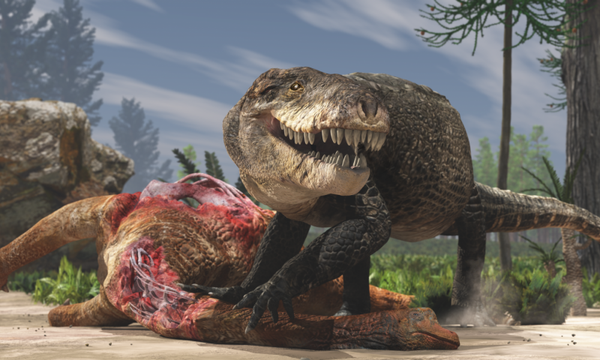
What the whole body of Razanandrongobe looked like is still unclear. The known material is restricted to the jaws. But, Cristiano Dal Sasso, Maganuco, and coauthors report, it's enough to narrow down the identity of this chomper to a branch of ancient crocodiles called mesoeucrocodylians. But given that paleo fans love superlative meat eaters, what's making headlines is that this old croc was a carnivorous giant.
Based upon the available material, Dal Sasso and colleagues estimate that Razanandrongobe was the largest Jurassic croc in the terrestrial realm, far larger than today's Nile crocodile. More than that, the deep jaws and thick, coarsely-serrated teeth of Razanandrongobe hint that this croc could make the most of carcasses, crushing bone and other hard parts just like our old favorite Tyrannosaurus is thought to have done. With any luck, future fieldwork will reveal more of this exceptional Jurassic crusher.

Part of the jaw of Razanandrongobe. Credit: Dal Sasso et al 2017
Fossil Facts
On supporting science journalism
If you're enjoying this article, consider supporting our award-winning journalism by subscribing. By purchasing a subscription you are helping to ensure the future of impactful stories about the discoveries and ideas shaping our world today.
Name: Razanandrongobe sakalavae
Meaning: Razanandrongobe is a combination of the Malagasy words for ancestor, large, and lizard, while sakalavae is a tribute to the Sakalava people from the area the fossils were found.
Age: Jurassic, about 165 million years ago.
Where in the world?: Mahajanga Basin, Madagascar.
What sort of organism?: A crocodile belonging to a group called notosuchians.
How much of the organism’s is known?: Parts of the jaw and a tooth crown.
Reference:
Dal Sasso, C. Pasini, G., Fleury, G., Maganuco, S. 2017. Razanandrongobe sakalavae, a gigantic mesoeucrocodylian from the Middle Jurassic of Madagascar, is the oldest known notosuchian. PeerJ. doi: 10.7717/peerj.3481
Maganuco, S., Dal Sasso, C., Pasini, G. 2006. A new large predatory archosaur from the Middle Jurassic (Bathonian) of Madagascar. Atti della Società Italiana di Scienze Naturali e del Museo Civico di Storia Naturale in Milano. 147 (I): 19-51
Previous Paleo Profiles:
The Light-Footed Lizard The Maoming Cat Knight’s Egyptian Bat The La Luna Snake The Rio do Rasto Tooth Bob Weir's Otter Egypt's Canine Beast The Vastan Mine Tapir Pangu's Wing The Dawn Megamouth The Genga Lizard The Micro Lion The Mystery Titanosaur The Echo Hunter The Lo Hueco Titan The Three-Branched Cicada The Monster of Minden The Pig-Footed Bandicoot Hayden's Rattlesnake Demon The Evasive Ostrich Seer The Paradoxical Mega Shark The Tiny Beardogs The Armored Fish King North America's Pangolin The Invisible-Tusked Elephant The Mud Dragon The Spike-Toothed Salmon The Dream Coast Crocodile Buriol's Robber Ozimek's Flyer The Northern Naustoceratopsian The High Arctic Flyer The Tomatillo From the End of the World The Short-Faced Hyena The Mighty Traveler from Egg Mountain Keilhau's Ichthyosaur Mexico's Ancient Horned Face Mauricio Fernández's Plesiosaur New Zealand's Giant Dawn Penguin The Orange Sea Lion Mongolia's Ginkgo Cousin The Geni River Frog Isabel Berry's Dinosaur The Whale Caiman The Moab Lizard Yang Zhongjian's Lizard The Little Anubis The Shuangbai Lizard The Wyvern Dinosaur The "Need Helmet" Dinosaur The Jianianhua Dragon The Liaoning Hunter The Dalian Lizard Crompton's Aleodon Jenkins' Amphibian Serpent From the Chinle