
This article was published in Scientific American’s former blog network and reflects the views of the author, not necessarily those of Scientific American
When I think sauropod, I think of North America's Jurassic giants. That's probably because these dinosaurs - Diplodocus, Supersaurus, Brachiosaurus, Apatosaurus, and more - historically lucked out in getting better press and more attention than all their other relatives. There's much more to the sauropod story than the hefty herbivores excavated from the deserts of the four corners, of course. Paleontologists have been finding and naming new sauropod dinosaurs at a relentless pace, and the latest comes from the approximately 72 million year old rock of central Spain.
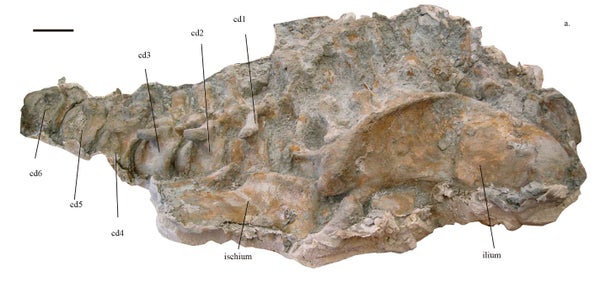
Paleontologist V. Díez Díaz and colleagues have named the dinosaur Lohuecotitan pandafilandi. This huge herbivore was one of the titanosaurs, a specific lineage of sauropod that spread the world over during the Cretaceous, and the collection of vertebrae, hip bones, and limb elements makes Lohuecotitan the most complete titanosaur yet discovered from the Late Cretaceous of Europe.
Back in the time of Lohuecotitan, central Spain was very different. The dinosaur trod a muddy floodplain that sat closer to the coast of the ancient Ibero-Armorican Island that formed part of an ancient European archipelago, Díez Díaz and coauthors write. Other big sauropods called this island chain home around the same time, such as Ampelosaurus and Atsinganosaurus from France, but precisely how these dinosaurs relate to each other - and how many sauropod species there were in these habitats - is unknown. Lohuecotitan is another piece to the prehistoric puzzle, holding the promise of more out there waiting for a paleontologist to have a lucky day.
On supporting science journalism
If you're enjoying this article, consider supporting our award-winning journalism by subscribing. By purchasing a subscription you are helping to ensure the future of impactful stories about the discoveries and ideas shaping our world today.

Limb elements of Lohuecotitan. Credit: Díez Díaz et al. 2016
Fossil Facts
Name: Lohuecotitan pandafilandi
Meaning: Lohuectotitan means "Lo Hueco titan", denoting where the dinosaur was found as well as its size, and pandafilandi is a reference to the character Pandafilando de la fosca vista in Miguel de Cervantes' The Ingenious Gentleman Don Quixote of La Mancha.
Age: Cretaceous, around 72 million years old.
Where in the world?: Cuenca, central Spain.
What sort of critter?: A sauropod dinosaur belonging to the titanosaur lineage.
Size: Unknown.
How much of the creature’s body is known?: A partial skeleton including vertebrae, parts of the hips and limbs, and several indeterminate pieces.
Reference:
Díez Díaz, V., Mocho, P. Páramo, A., Escaso, F., Marcos-Fernández, F., Sanz, J., Ortega, F. 2016. A new titanosaur (Dinosauria, Sauropoda) from the Upper Cretaceous of Lo Hueco (Cuenca, Spain). Cretaceous Research. doi: 10.1016/j.cretres.2016.08.001
Previous Paleo Profiles:
The Light-Footed Lizard The Maoming Cat Knight’s Egyptian Bat The La Luna Snake The Rio do Rasto Tooth Bob Weir's Otter Egypt's Canine Beast The Vastan Mine Tapir Pangu's Wing The Dawn Megamouth The Genga Lizard The Micro Lion The Mystery Titanosaur The Echo Hunter
