
This article was published in Scientific American’s former blog network and reflects the views of the author, not necessarily those of Scientific American
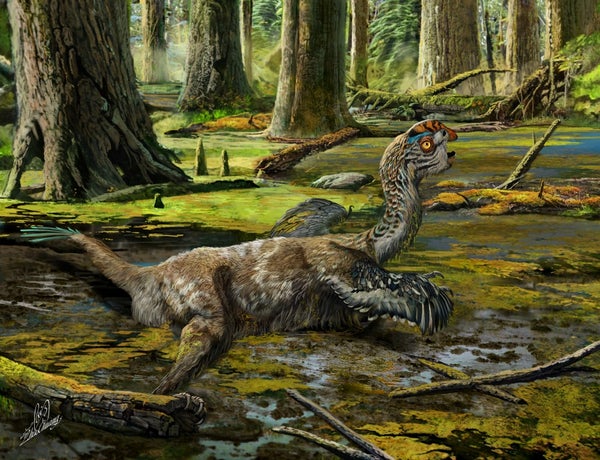
No one knows for sure how the Mud Dragon died. The 72-66 million year old dinosaur, excavated by a farmer and construction workers with the help of a little TNT, is nearly complete and seems to be reaching out to us through time. If the pose can be taken as preserving the moment of death, it's not difficult to imagine this parrot-like dinosaur struggling against the sucking mud of a Cretaceous swamp, too tired to kick anymore. Whether this actually happened or not is as yet unknown, but its nickname nevertheless conjures the image of a hopelessly-mired theropod.
What's clearer is what this new dinosaur - officially dubbed Tongtianlong limosus - says about dinosaurs in the days of the Late Cretaceous. In the paper describing the creature, paleontologists Junchang Lü, Stephen Brusatte, and colleagues point out that this is the sixth unique oviraptorid dinosaur found in the Late Cretaceous rock around Ganzhou, China. Within the last seven million years of the Cretaceous, just before the extinction that killed all the non-avian dinosaurs, these peculiar omnivores were undergoing a great diversification, new forms popping up right until the very end.
Paleontologists are continuing the debate whether non-avian dinosaurs went out with a bang or a whimper at the end of the Cretaceous. Some studies suggest that they thrived to the very last moment. Others conclude that something was happening to trim dinosaur body types and diversity in the last seven million years. There's no answer yet, especially given that so much of what is known about the extinction comes from only a few spots around the world. Not to mention that it may be that some dinosaur communities were being reshuffled while others were continuing to thrive in the way they had been. For now, though, Tongtianlong hints that some forms of dinosaurs were proliferating right into the last days of the Cretaceous, beckoning us to go out and find more fossils from this narrow, critical slice of dinosaurian history.

Prep work on the Mud Dragon. Credit: Junchang Lu
Fossil Facts
On supporting science journalism
If you're enjoying this article, consider supporting our award-winning journalism by subscribing. By purchasing a subscription you are helping to ensure the future of impactful stories about the discoveries and ideas shaping our world today.
Name: Tongtianlong limosus
Meaning: Tongtianlong is a combination of the Chinese Pinyin words for "the road to heaven", in reference to the dinosaur's outstretched arms, and dragon. The species name limosus is Latin for "muddy."
Age: Cretaceous, 72-66 million years old.
Where in the world?: Ganxian, China.
What sort of critter?: An oviraptorid dinosaur.
Size: About six and a half feet long.
How much of the creature’s body is known?: A nearly-complete skeleton.
Reference:
Lü, J., Chen, R., Brusatte, S., Zhu, Y., Shen, C. 2016. A Late Cretaceous diversification of Asian oviraptorid dinosaurs: evidence from a new species preserved in an unusual posture. Scientific Reports. doi: 10.1038/srep35780
Previous Paleo Profiles:
The Light-Footed Lizard The Maoming Cat Knight’s Egyptian Bat The La Luna Snake The Rio do Rasto Tooth Bob Weir's Otter Egypt's Canine Beast The Vastan Mine Tapir Pangu's Wing The Dawn Megamouth The Genga Lizard The Micro Lion The Mystery Titanosaur The Echo Hunter The Lo Hueco Titan The Three-Branched Cicada The Monster of Minden The Pig-Footed Bandicoot Hayden's Rattlesnake Demon The Evasive Ostrich Seer The Paradoxical Mega Shark The Tiny Beardogs The Armored Fish King North America's Pangolin The Invisible-Tusked Elephant