
This article was published in Scientific American’s former blog network and reflects the views of the author, not necessarily those of Scientific American
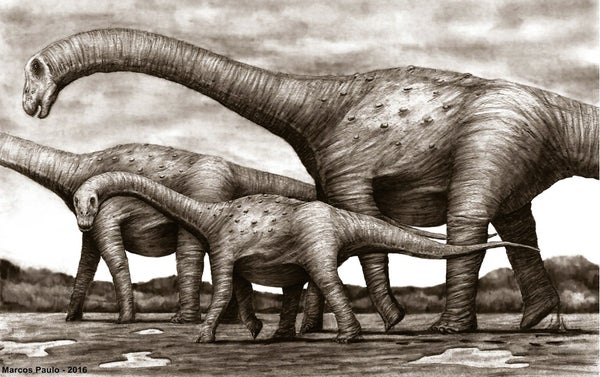
Titanosaurs truly lived up to their names. The largest of them, like the unnamed animal that fills a fourth floor hall at the American Museum of Natural History, stretched well beyond 100 feet in length and weighed more than 70 tons. Yet the early days of this iconic group of herbivores are as yet little known, and a single bone hints at a place paleontologists may be able to uncover more clues about the origins of true titans.
The lone bone - a fibula, or one of the bones of the lower leg - was found in the Early Cretaceous rock of Brazil. This was a lucky break. As paleontologist Aline Ghilardi and colleagues point out in their paper describing the fossil, only tracks had been found in the surrounding area before. While these showed that sauropod dinosaurs trod the area, the bone is the first dinosaur body fossil from what the experts call the Rio do Peixe basin complex.
At around 129 million years old, the bone is now the oldest titanosaur fossil from central Gondwana - the southern hemisphere landmass that included South America, Africa, Antarctica, India, and Australia. Unfortunately there isn't enough of the dinosaur to pin a name to, but, paired with numerous tracks made by larger animals, the fossil shows that titanosaurs already had a foothold in Cretaceous Brazil early on in the Cretaceous. With luck, further searches will fill out the form of these pioneering plant eaters.

The titanosaur fibula from Brazil. Credit: Ghilardi et al. 2016
Fossil Facts
On supporting science journalism
If you're enjoying this article, consider supporting our award-winning journalism by subscribing. By purchasing a subscription you are helping to ensure the future of impactful stories about the discoveries and ideas shaping our world today.
Name: The dinosaur does not have a formal scientific name yet.
Age: Cretaceous, around 129 million years old.
Where in the world?: Sousa Basin, Brazil.
What sort of critter?: A titanosaur.
Size: Estimated at four and a half feet at the hip, although this was not a fully-grown individual.
How much of the creature’s body is known?: A single fibula.
Reference:
Ghilardi, A., Aureliano, T., Duque, R., Fernandes, M., Barreto, A., Chinsamy, A. 2016. A new titanosaur from the Lower Cretaceous of Brazil. Cretaceous Research. doi: 10.1016/j.cretres.2016.07.001
Previous Paleo Profiles:
The Light-Footed Lizard The Maoming Cat Knight’s Egyptian Bat The La Luna Snake The Rio do Rasto Tooth Bob Weir's Otter Egypt's Canine Beast The Vastan Mine Tapir Pangu's Wing The Dawn Megamouth The Genga Lizard The Micro Lion
