
This article was published in Scientific American’s former blog network and reflects the views of the author, not necessarily those of Scientific American
This has been the year of the troodontid - the feathery almost-but-not-quite-a-bird dinosaurs that scampered around the Jurassic and Cretaceous world. Over the past twelve months alone we've been introduced to Zhongjianosaurus, Jianianhualong, Liaoningvenator, Albertavenator, and Latenivenatrix from the ancient strata of China and Canada, not to mention that Stenonychosaurus - a genus once discarded - is now back on the rollcall of valid dinosaurs. Given this embarrassment of fuzzy, sickle-clawed dinosaurs, it's only fitting that I end this year of Paleo Profiles by introducing you to one more.
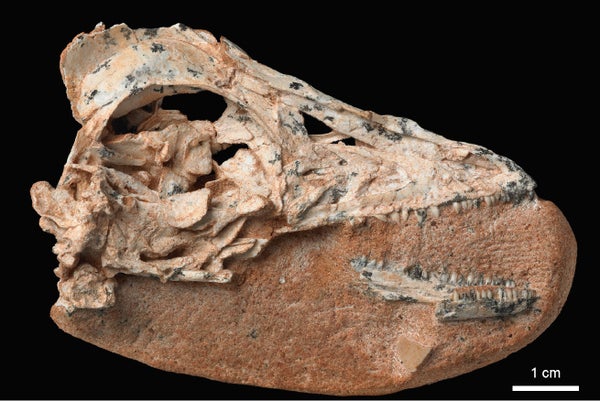
Almas ukhaa, named by paleontologist Rui Pei and colleagues, comes from the 75-71 million year old treasure trove of Ukhaa Tolgod, Mongolia. This is the area that's yielded dozens of dinosaur eggs, Protoceratops, Velociraptor, nesting oviraptorosaurs, and other spectacular finds all wrapped up in rust-red stone. Almas is the latest to join the esteemed list, a troodontid dinosaur immediately recognizable from its slender jaws packed with tiny, sharp teeth. Characteristics of its skull, hip, and vertebrae, the researchers report, distinguish this dinosaur as something new.
Not that Almas was the only troodontid around. At least five different troodontids have been named from the same formation or its nearby equivalents, Pei and coauthors write. Why so many? Well, that's the question.
On supporting science journalism
If you're enjoying this article, consider supporting our award-winning journalism by subscribing. By purchasing a subscription you are helping to ensure the future of impactful stories about the discoveries and ideas shaping our world today.
Perhaps Almas and the other troodontids lived at different slices of time within the four-million-year span of the Djadokhta Formation. Maybe they occupied different niches. Or they could have been geographic neighbors that didn't overlap in space despite living at the same time. Then again, if we only knew modern day rodents or birds from rare, scattered bones we might think of them as too similar to coexist on the same landscape even if they actually did. (The same questions surround troodontids found in the Early Cretaceous rocks of China, as well.) Troodontid diversity and success - at least until that extinction-causing asteroid struck - is still mysterious. But this is what keeps paleontology going. Find one dinosaur and you unearth a dozen questions to go with it.

The skull and skeleton of Almas. Credit: Pei et al 2017
Name: Almas ukhaa
Meaning: Almas is a nod to a "wild man" in Mongolia myth, while ukhaa is after Ukhaa Tolgod where the fossil was found.
Age: Cretaceous, 75-71 million years ago.
Where in the world?: Ukhaa Tolgod, Mongolia.
What sort of organism?: A troodontid dinosaur.
How much of the organism’s is known?: A nearly-complete skull and part of the postcranial skeleton.
References:
Pei, R., Norell, M., Barta, D., Bever, G., Pittman, M., Xu, X. 2017. Osteology of a new Late Cretaceous troodontid specimen from Ukhaa Tolgod, Ömnögovi Aimag, Mongolia. American Museum Novitates. 3889.
Previous Paleo Profiles:
The Light-Footed Lizard The Maoming Cat Knight’s Egyptian Bat The La Luna Snake The Rio do Rasto Tooth Bob Weir's Otter Egypt's Canine Beast The Vastan Mine Tapir Pangu's Wing The Dawn Megamouth The Genga Lizard The Micro Lion The Mystery Titanosaur The Echo Hunter The Lo Hueco Titan The Three-Branched Cicada The Monster of Minden The Pig-Footed Bandicoot Hayden's Rattlesnake Demon The Evasive Ostrich Seer The Paradoxical Mega Shark The Tiny Beardogs The Armored Fish King North America's Pangolin The Invisible-Tusked Elephant The Mud Dragon The Spike-Toothed Salmon The Dream Coast Crocodile Buriol's Robber Ozimek's Flyer The Northern Naustoceratopsian The High Arctic Flyer The Tomatillo From the End of the World The Short-Faced Hyena The Mighty Traveler from Egg Mountain Keilhau's Ichthyosaur Mexico's Ancient Horned Face Mauricio Fernández's Plesiosaur New Zealand's Giant Dawn Penguin The Orange Sea Lion Mongolia's Ginkgo Cousin The Geni River Frog Isabel Berry's Dinosaur The Whale Caiman The Moab Lizard Yang Zhongjian's Lizard The Little Anubis The Shuangbai Lizard The Wyvern Dinosaur The "Need Helmet" Dinosaur The Jianianhua Dragon The Liaoning Hunter The Dalian Lizard Crompton's Aleodon Jenkins' Amphibian Serpent From the Chinle The Large Ancestor Lizard The Crown Tooth Currie's Alberta Hunter The Elephant Bird Mimic The Crested Thief The Hiding Hunter The Horned Lizard The Silk Bird The Sieve-Toothed Plesiosaur The Defenseless Snout Burian's Lizard The Small Whaitsiid The Beautiful Bird The Fierce Cat The Older One From Melksham The King of the Miocene Iberian Giraffes Miera's Lizard The Traveling Sloth The Sand Whale Shouten's Marsupial Lion The Rhaetian Lizard
