
This article was published in Scientific American’s former blog network and reflects the views of the author, not necessarily those of Scientific American
Taxonomy doesn't give a damn about personal preferences. As "Brontosaurus" taught us, a favored name can easily be overtaken by a less-popular moniker according to the arcana that dictate how species are named and arranged in the tree of life. So it was with the saber-toothed salmon.
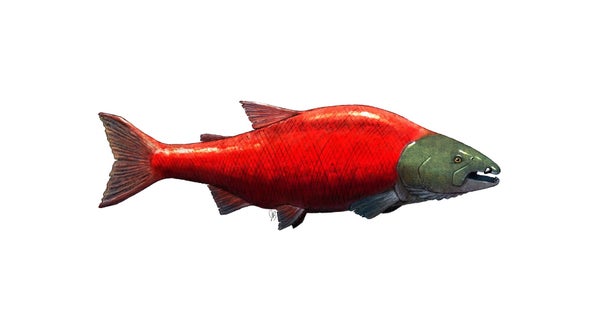
Back in 1972 paleontologists T. Cavender and R.R. Miller named a huge fossil fish from the Pliocene deposits of Oregon. They called it Smilodonichthys rastrosus - the "knife fish." The fish's impressive teeth were thought to stick straight down, like those of a sabertooth cat, and so it became known as the sabertooth salmon.
But now the same fish is known by different names. The official title is now Oncorhynchus rastrosus - a species in the same genus as today's Pacific salmon - and those impressive teeth have been rearranged to stick out sideways rather than down. This fish is the sabertoothed salmon no more. It's the spike-toothed salmon.
These fish didn't use their teeth to slash open prey. In a new paper on this impressive swimmer, paleontologist Julia Sankey and colleagues confirmed that this ancient salmon behaved much like its modern counterparts.
Oncorhynchus rastrosus didn't have spike teeth its whole life, but rather developed them as they transitioned from life in the ocean to their breeding phase in freshwater. Pacific salmon undergo the same kind of metamorphosis today. On top of that, Sankey and colleagues found, the large teeth found in freshwater deposits are more worn-down than those found in the ocean, indicating that these fish were using their teeth to defend their territories and make their nests. Imagine if these fish were still around. We might see grizzly bears grappling spike-toothed fish as large as themselves out of the water during salmon runs, making the annual displays of life and death all the more impressive.
On supporting science journalism
If you're enjoying this article, consider supporting our award-winning journalism by subscribing. By purchasing a subscription you are helping to ensure the future of impactful stories about the discoveries and ideas shaping our world today.

Teeth from the freshwater phase of the spike-toothed salmon. Credit: Sankey et al. 2016
Fossil Facts
Name: Oncorhynchus rastrosus
Nickname: The spike-toothed salmon.
Age: Pliocene, 12-5 million years ago.
Where in the world?: California, Oregon, and Washington, U.S.A.
What sort of critter?: A salmon.
Size: About eight feet long.
How much of the creature’s body is known?: Multiple specimens, including the gill rakers and teeth.
Reference:
Sankey, J., Biewer, J., Basuga, J., Francisco, P., Wagner, H., Garber, D. 2016. The giant, spike-toothed salmon, Oncorhynchus rastrosus and the Proto-Tuolumne River (early Pliocene) of Central California. PaleoBios. 33: 1-16
Previous Paleo Profiles:
The Light-Footed Lizard The Maoming Cat Knight’s Egyptian Bat The La Luna Snake The Rio do Rasto Tooth Bob Weir's Otter Egypt's Canine Beast The Vastan Mine Tapir Pangu's Wing The Dawn Megamouth The Genga Lizard The Micro Lion The Mystery Titanosaur The Echo Hunter The Lo Hueco Titan The Three-Branched Cicada The Monster of Minden The Pig-Footed Bandicoot Hayden's Rattlesnake Demon The Evasive Ostrich Seer The Paradoxical Mega Shark The Tiny Beardogs The Armored Fish King North America's Pangolin The Invisible-Tusked Elephant The Mud Dragon