
This article was published in Scientific American’s former blog network and reflects the views of the author, not necessarily those of Scientific American
Fossils species are named after all sorts of things. Some titles say something about an essential trait of the animal. Others are references to rock stars. Some mean nothing at all. In the case of a Cretaceous lizard recently uncovered in Italy, the inspiration was wine.
Primitivus manduriensis, named after Primitivo di Manduria wine made in the region of Italy the reptile was recovered in, is a sinuous surprise. The nearly-complete skeleton is not only articulated, but also retains fossilized remnants of the lizard's muscles, cartilage, skin, and gut contents. As for as Cretaceous time capsules go, Primitivus is more detailed than most.
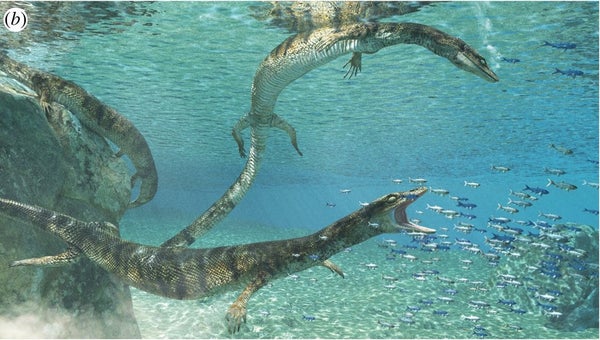
In the broader evolutionary picture, paleontologist Ilaria Paparella and colleagues write, Primitivus is a marine reptile belonging to a broader group called dolichosaurids. As you might guess from the reptile's somewhat lanky look, dolichosaurids are distant relatives of mosasaurs and snakes.
On supporting science journalism
If you're enjoying this article, consider supporting our award-winning journalism by subscribing. By purchasing a subscription you are helping to ensure the future of impactful stories about the discoveries and ideas shaping our world today.
But part of what makes Primitivus stand out - and why the genus name sticks - is because this reptile looks relatively archaic for its time and place. Dolichosaurids were thought to have gone extinct about 10 million years earlier, so, Paparella and coauthors suggest, the roughly 72 million-year-old Primitivus is a relict that represents a form of lizard that survived on the sidelines while its mosasaur cousins were ruling the aquatic realm. This also means that there have to be other, as-yet-unrecognized dolichosaurids out there awaiting discovery. Perhaps there will be enough to fill a wine cellar's-worth.
Name: Primitivus manduriensis
Meaning: The full name is a reference to a wine made near where the fossil was found, Primitivo di Manduria.
Age: Cretaceous, about 72 million years old.
Where in the world?: Puglia, Italy.
What sort of organism?: A lizard belonging to a larger group called dolichosaurids and distantly related to mosasaurs and snakes.
How much of the organism’s is known?: A partial skeleton.
Reference:
Paparella, I., Palci, A., Nicosia, U., Caldwell, M. 2018. A new fossil marine lizard with soft tissues from the Late Cretaceous of southern Italy. Royal Society Open Science. doi: 10.1098/rsos.172411
More Paleo Profiles:
The Light-Footed Lizard The Maoming Cat Knight’s Egyptian Bat The La Luna Snake The Rio do Rasto Tooth Bob Weir's Otter Egypt's Canine Beast The Vastan Mine Tapir Pangu's Wing The Dawn Megamouth The Genga Lizard The Micro Lion The Mystery Titanosaur The Echo Hunter The Lo Hueco Titan The Three-Branched Cicada The Monster of Minden The Pig-Footed Bandicoot Hayden's Rattlesnake Demon The Evasive Ostrich Seer The Paradoxical Mega Shark The Tiny Beardogs The Armored Fish King North America's Pangolin The Invisible-Tusked Elephant The Mud Dragon The Spike-Toothed Salmon The Dream Coast Crocodile Buriol's Robber Ozimek's Flyer The Northern Naustoceratopsian The High Arctic Flyer The Tomatillo From the End of the World The Short-Faced Hyena The Mighty Traveler from Egg Mountain Keilhau's Ichthyosaur Mexico's Ancient Horned Face Mauricio Fernández's Plesiosaur New Zealand's Giant Dawn Penguin The Orange Sea Lion Mongolia's Ginkgo Cousin The Geni River Frog Isabel Berry's Dinosaur The Whale Caiman The Moab Lizard Yang Zhongjian's Lizard The Little Anubis The Shuangbai Lizard The Wyvern Dinosaur The "Need Helmet" Dinosaur The Jianianhua Dragon The Liaoning Hunter The Dalian Lizard Crompton's Aleodon Jenkins' Amphibian Serpent From the Chinle The Large Ancestor Lizard The Crown Tooth Currie's Alberta Hunter The Elephant Bird Mimic The Crested Thief The Hiding Hunter The Horned Lizard The Silk Bird The Sieve-Toothed Plesiosaur The Defenseless Snout Burian's Lizard The Small Whaitsiid The Beautiful Bird The Fierce Cat The Older One From Melksham The King of the Miocene Iberian Giraffes Miera's Lizard The Traveling Sloth The Sand Whale Shouten's Marsupial Lion The Rhaetian Lizard The Mountain Dolphin The Bryant's Shark The Rainbow Dinosaur Kootenay Bristle Worm The Masaoura Lizard The Chimera Spider The Chad Cat The Jinyun Shield The Fish From China The Sobrarbe Siren The Shortened Face The Climbing Dwarf Martin's Sea Turtle The Nonsense Beetle The Stardust Beast
