
This article was published in Scientific American’s former blog network and reflects the views of the author, not necessarily those of Scientific American
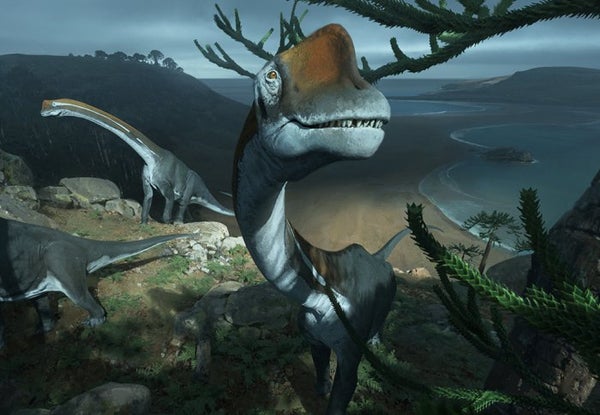
Brachiosaurus has always had a special place in my heart. Sure, Brontosaurus was my first love, but I was always fascinated by how different Brachiosaurus looked compared to the other sauropods of its time. The "arm lizard" stood tall, its chest pushed up high on pillar-like forelimbs, neck tilted high into the air and capped by a peculiar skull boasting a crest of bone. (At least, if its close relative Giraffatitan is anything to go by.) There was nothing else quite like it stomping around the floodplains of the Jurassic west. But what came before Brachiosaurus? A newly-named dinosaur from France helps answer that question.
Paleontologist Philip Mannion and colleagues have named the dinosaur Vouivria damparisensis. Despite earning a new name, the dinosaur's bones aren't new to science. The fossils were originally excavated in the 1934 and briefly described nine years later, but experts didn't realize the significance of the saurian until the new study. It turns out that the "Damparis sauropod" is not only a previously-unknown species, but the oldest brachiosaurid yet found.
Vouivria lived about ten million years before the great sauropod boom of 150 million years ago. Whether it pins ancient Europe as the place these dinosaurs evolved is unknown, but close relatives of Vouivria soon stomped around what would become North America, Europe, and Africa. From there, though, brachiosaurs started to shrink back. The Cretaceous forms were restricted to North America and Africa, with the last of their kind disappearing about 100 million years ago. Such a record is nothing to sneeze at, though, and hopefully future finds will fill in additional details about how these veggiesaurs evolved.

Neck vertebrae of Vouivria. Credit: Mallon et al 2017
Fossil Facts
On supporting science journalism
If you're enjoying this article, consider supporting our award-winning journalism by subscribing. By purchasing a subscription you are helping to ensure the future of impactful stories about the discoveries and ideas shaping our world today.
Name: Vouivria damparisensis
Meaning: The etymology of Vouivria is a little complex. The researchers write, "The generic name is derived from the old French word ‘vouivre’, itself from the Latin ‘vipera’, meaning ‘viper’. In Franche-Comté, the region in which the holotype was discovered, ‘la vouivre’ (=the wyvern) is a legendary winged reptile. In the homonym novel written by the great French author Marcel Aymé, ‘La Vouivre’ is a beautiful woman who lives in the swamps in the neighbourhood of Dôle (Franche-Comté) and protects a spectacular ruby." The species name damparisensis is a nod to Damparis, where the fossils were found.
Age: Jurassic, over 160 million years ago.
Where in the world?: Damparis, France.
What sort of organism?: A sauropod related to Brachiosaurus.
Size: Estimated at 50 feet long.
How much of the organism’s is known?: An associated skeleton including teeth, vertebrae, and ribs, as well as elements of the hips, shoulders, arms, legs, and feet.
Reference:
Mallon, P., Allain, R., Moine, O. 2017. The earliest known titanosauriform sauropod dinosaurs and the evolution of Brachiosauridae. PeerJ. doi: 10.7717/peerj.3217
Previous Paleo Profiles:
The Light-Footed Lizard The Maoming Cat Knight’s Egyptian Bat The La Luna Snake The Rio do Rasto Tooth Bob Weir's Otter Egypt's Canine Beast The Vastan Mine Tapir Pangu's Wing The Dawn Megamouth The Genga Lizard The Micro Lion The Mystery Titanosaur The Echo Hunter The Lo Hueco Titan The Three-Branched Cicada The Monster of Minden The Pig-Footed Bandicoot Hayden's Rattlesnake Demon The Evasive Ostrich Seer The Paradoxical Mega Shark The Tiny Beardogs The Armored Fish King North America's Pangolin The Invisible-Tusked Elephant The Mud Dragon The Spike-Toothed Salmon The Dream Coast Crocodile Buriol's Robber Ozimek's Flyer The Northern Naustoceratopsian The High Arctic Flyer The Tomatillo From the End of the World The Short-Faced Hyena The Mighty Traveler from Egg Mountain Keilhau's Ichthyosaur Mexico's Ancient Horned Face Mauricio Fernández's Plesiosaur New Zealand's Giant Dawn Penguin The Orange Sea Lion Mongolia's Ginkgo Cousin The Geni River Frog Isabel Berry's Dinosaur The Whale Caiman The Moab Lizard Yang Zhongjian's Lizard The Little Anubis The Shuangbai Lizard
