
This article was published in Scientific American’s former blog network and reflects the views of the author, not necessarily those of Scientific American
We're in an age of Feathered Dinosaur Fatigue. In the 90s, when Jurassic Park canonized the image of dinosaurs as scaly in the public imagination, the discovery of any new dinosaur bearing fluff, fuzz, or feathers was a wonder. Now the list of known fluffy dinosaur species stands in the dozens, and it's easy for newly-named animals to slip under the radar. But that doesn't mean that these animals are no longer worthy of our attention. From a partial skeleton found in Cretaceous China, paleontologists Xu Xing and Qin Zi-Chuan have named one of the tiniest feathered dinosaurs yet discovered.
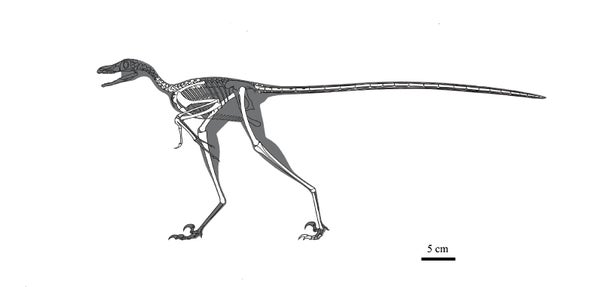
The new dinosaur is named Zhongjianosaurus yangi. Weighing in at an estimated 0.6 of a pound, this dinosaur was certainly in the featherweight class. On top of that, the paleontologists write, this dinosaur's comparatively small size might be a clue to a phenomenon well-known among living animals but hard to detect among dinosaurs.
Niche partitioning is what allows diversity to exist in whatever habitat you look at. In short, it's the concept that different species inhabit and utilize a particular space in different ways and this allows various species to coexist. In the case of China's Jehol Group, in which Zhongjianosaurus was found, as many as nine different species of dromaeosaurid dinosaur have been found. Were all these little Velociraptor relatives living alongside one another, and, if so, how did they do it?
How many dromaeosaurids lived alongside each other isn't clear yet. Some of the named species might be determined to be synonyms of others, and the geological resolution isn't refined enough to get a clear picture of whether all these dinosaurs lived at the exact same time or represent different communities through time. (Five million years is nothing to sneeze at.) All the same, Zhongjianosaurus and its possible neighbors came in a variety of sizes with significant differences in their arms and teeth. There were larger, ground-based predators (Tianyuraptor), medium-sized gliding omnivores (Microraptor), and tiny dinosaurs that may have specialized on smaller morsels (like Zhongjianosaurus). Dinosaurs were part of ecological communities, no single species standing alone, and perhaps one day we'll know how so many fluffy little flappers managed to carve out their respective careers alongside each other.

Selected bones of Zhongjianosaurus. Credit: Xing and Zi-Chuan 2017
Fossil Facts
On supporting science journalism
If you're enjoying this article, consider supporting our award-winning journalism by subscribing. By purchasing a subscription you are helping to ensure the future of impactful stories about the discoveries and ideas shaping our world today.
Name: Zhongjianosaurus yangi
Meaning: Yang Zhongjian's lizard, in honor of "the founder of vertebrate paleontology in China."
Age: Cretaceous, between 125 and 120 million years old.
Where in the world?: Liaoning Province, China.
What sort of organism?: A dromaeosaurid dinosaur.
Size: Small, estimated to weigh 0.6 of a pound.
How much of the organism’s is known?: A partial skeleton.
Reference:
Xing, X., Zi-Chuan, Q. 2017. A new tiny dromaeosaurid dinosaur from the Cretaceous Jehol Group of western Liaoning and differeentiation among the Jehol dromaeosaurids. Vertebrata PalAsiatica.
Previous Paleo Profiles:
The Light-Footed Lizard The Maoming Cat Knight’s Egyptian Bat The La Luna Snake The Rio do Rasto Tooth Bob Weir's Otter Egypt's Canine Beast The Vastan Mine Tapir Pangu's Wing The Dawn Megamouth The Genga Lizard The Micro Lion The Mystery Titanosaur The Echo Hunter The Lo Hueco Titan The Three-Branched Cicada The Monster of Minden The Pig-Footed Bandicoot Hayden's Rattlesnake Demon The Evasive Ostrich Seer The Paradoxical Mega Shark The Tiny Beardogs The Armored Fish King North America's Pangolin The Invisible-Tusked Elephant The Mud Dragon The Spike-Toothed Salmon The Dream Coast Crocodile Buriol's Robber Ozimek's Flyer The Northern Naustoceratopsian The High Arctic Flyer The Tomatillo From the End of the World The Short-Faced Hyena The Mighty Traveler from Egg Mountain Keilhau's Ichthyosaur Mexico's Ancient Horned Face Mauricio Fernández's Plesiosaur New Zealand's Giant Dawn Penguin The Orange Sea Lion Mongolia's Ginkgo Cousin The Geni River Frog Isabel Berry's Dinosaur The Whale Caiman The Moab Lizard
