
This article was published in Scientific American’s former blog network and reflects the views of the author, not necessarily those of Scientific American
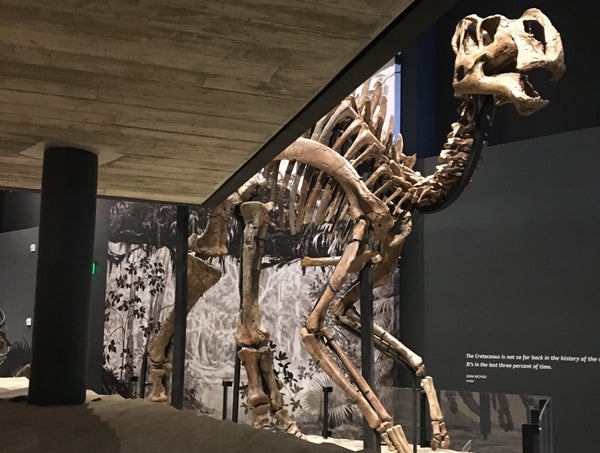
“Duckbilled dinosaurs” never looked very much like ducks to me. The herbivorous dinosaurs – technically known as hadrosaurs – have densely-packed batteries of teeth, for starters, and their snouts look awfully squared-off compared to a mallard’s. Not to mention that the beaks of these dinosaurs were covered in ridged keratin sheaths that gave them more of a shovel shape in life. I didn’t expect the idea to catch on, but in 2012 I suggested that we call “duckbilled” dinosaurs “shovel-beaked” instead.
Decades of paleo popularization are difficult to subvert, though, and even though I’ve tried to use shovel-beaked where I could, most of the time I’ve been told to revert to duckbilled to avoid confusion. I don’t think paleontologist Darren Naish’s 2018 suggestion that we drop the duckbills has caught on, either. But at least the idea has convergently evolved within the technical literature. Paleontologists Albert Prieto-Márquez, Jonathan Wagner, and Thomas Lehman have named what they’re calling a “shovel-billed” hadrosaur from Texas.
The newly-named dinosaur, found in strata more than 76 million years old, is called Aquilarhinus palimentus. Superficially, the Cretaceous dinosaur looks like related species that came soon after. If you’re familiar with Gryposaurus or Kritosaurus, you’ve got the idea, and the resemblance helps demonstrate that hadrosaurs had bony crests during their early evolution and these ornaments were expanded in some later lineages while totally lost in others. But most striking of all is the dinosaur’s mouth.
On supporting science journalism
If you're enjoying this article, consider supporting our award-winning journalism by subscribing. By purchasing a subscription you are helping to ensure the future of impactful stories about the discoveries and ideas shaping our world today.
Aquilarhinus has a weird lower jaw. The two bones that make it up, Prieto-Márquez and colleagues write, are long and angle to the sides such that the two bones meet in a W-shape at the front. There’s nothing duck-like about it. This is a broad-snouted dinosaur, and the researchers describe the reconstructed lower beak shape of the dinosaur like “two trowels laid side to side.” The top jaw likely made a vertical shovel while the lower beak jutted out horizontally, creating for an odd set of Mesozoic salad tongs.
Why Aquilarhinus evolved a broad skull and shovel-shaped break is another matter. Prieto-Márquez and coauthors suggest that these might be feeding adaptations. Perhaps Aquilarhinus scooped up vegetation with its break, much the way shovel-tusked elephants like Platybelodon were thought to. But that’s exactly it. As it turns out, the “shovel-tuskers” may have been saw-tuskers that used their flattened, specialized teeth to cut through tough vegetation rather than trowel up mouthfuls of soft plants. We can certainly recognize structures in extinct animals that remind us of tools we’ve invented, but that doesn’t necessarily mean those animals used their anatomy in the way we immediately envision. Aquilarhinus is certainly unusual, but exactly how this dinosaur plowed a living for itself in the lush Cretaceous world remains to be seen.