
This article was published in Scientific American’s former blog network and reflects the views of the author, not necessarily those of Scientific American
Penguins are dinosaurs. It’s true. Way back in the Jurassic, birds were just one of many, many dinosaur lineages. Extinction wiped out all the rest, leaving avian dinosaurs the only ones still standing. Or fluttering, as the case may be. That means every bird alive today is a dinosaur in the same way that you and I are mammals, and learning more about birds can convey some essential information about dinosaurs. Fossil penguin skin found in Antarctica, for example, has underscored the hypothesis that non-avian dinosaurs were fluffier than we presently know.
The fossil in question, described by Carolina Hospitaleche and colleagues, is a specimen of an ancient penguin called Palaeeudyptes gunnari that lived around what’s now Seymour Island about 47-41 million years ago. It’s not a full skeleton, but an articulated wing covered in remnants of the bird’s soft tissues. It’s about as close as we can expect to get to seeing the living penguin’s wing anatomy.
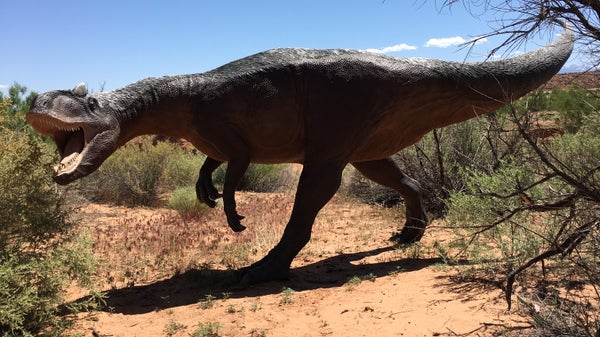
Despite the stunning preservation, however, the fossil doesn’t seem to preserve any feathers. Instead, Hospitaleche and coauthors report, the only sign of the feathers are the follicles the bird’s plumage grew out of. Without a halo of feathery fluff, the preserved skin looks pockmarked and scaly. If you didn’t know what you were looking at, you might think this was the skin of a non-avian dinosaur. And that raises a significant point.
On supporting science journalism
If you're enjoying this article, consider supporting our award-winning journalism by subscribing. By purchasing a subscription you are helping to ensure the future of impactful stories about the discoveries and ideas shaping our world today.
We now know that many non-avian dinosaurs sported some kind of fluff, fuzz, or feathers. The distribution of these body coverings across the dinosaur family also indicates that floof evolved more than once, or that it goes back to the last common ancestor of the entire family. Still, paleontology can be conservative when it comes to restorations. Scales are the default, with feathers often depicted only in those cases where we have definitive fossil evidence of their presence.
But maybe we’re missing something. Perhaps there are scraps of skin from dinosaurs like Tyrannosaurus, or even the shovel-beaked hadrosaurs, that preserve plumage follicles. Perhaps they’ve been missed because we never expected them to be there in the first place. On top of that, we know that Palaeeudyptes gunnari had feathers, yet the plumage itself wasn’t preserved. Feathers and their evolutionary precursors don’t always make it into the fossil record, even when the rest of the body looks exquisitely intact, and we know relatively little about the circumstances behind these geological biases.
With all that in mind, think about announcements that Tyrannosaurus was scaly because a few scraps of skin have been found. Do we know where they fit on the body? Do they lack any sign of feather follicles? Is it possible that the feathery body coverings of such dinosaurs suffered barriers to preservation? Personally, I think we are severely underestimating just how fuzzy dinosaurs could be. We’re reading the fossil record too literally. If dinosaurs turn out to be fluffier than the depictions I grew up with, let's say you won't be able to knock me over with a feather.