
This article was published in Scientific American’s former blog network and reflects the views of the author, not necessarily those of Scientific American
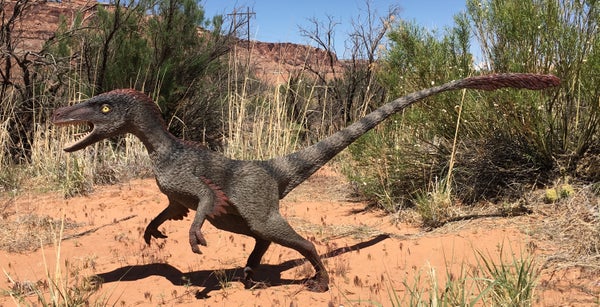
Perhaps the most iconic thing about Jurassic Park’s raptors* is that they work together. Before we even see them on screen - in the flesh, at least - Alan Grant is terrorizing his field crew with tales of the dinosaurs' pack-hunting prowess. But did these dinosaurs really team up in real life?
The anatomy and behavior of the Jurassic franchise’s Velociraptor was based on another animal called Deinonychus. I won’t rehash the whole history here, but suffice it to say that a bonebed of multiple Deinonychus surrounding the bones of a herbivorous dinosaur was taken as evidence that these carnivores worked together to fell their victim. That evidence has been questioned, and rightly so given the complexities of how bonebeds form. (Buried together doesn’t necessarily mean intertwined in life.) But there is another line of evidence that hints that Velociraptor-like dinosaurs were social at least some of the time - tracks.
Tracks made by gregarious, raptor-like dinosaurs aren’t exactly new to paleontologists. In 2008 paleontologists described parallel trackways made by Velociraptor-like dinosaurs that walked side by side for a time. The exact species that left the imprints isn’t clear, but the characteristic two-toed imprints - with the killing claw held off the ground - made it clear that these were deinonychosaurs, or the larger group to which dinosaurs like Velociraptor and Troodon belong.
On supporting science journalism
If you're enjoying this article, consider supporting our award-winning journalism by subscribing. By purchasing a subscription you are helping to ensure the future of impactful stories about the discoveries and ideas shaping our world today.
The discovery wasn’t a one-off. Other deinonychosaur tracks show signs of interaction, including a large set just announced this year.
These tracks, paleontologist Lida Xing and colleagues report, rest among an aggregation of about 300 dinosaur footprints preserved in the Early Cretaceous rock of eastern China. Of the approximately seven types of track forms found there, though, two belong to a trace fossil type ichnologists call Menglongpus - two-toed traces made by deinonychosaurs. And in this case, there are four deinonychosaur trackways that run alongside each other.
Each of the four trackways has 15-18 footprints, oriented in roughly the same direction. And, at first, they might seem a little strange. Instead of a clean V like the fake tracks made for Jurassic Park, the footprints might initially look like they’re single-toed. But modern ostriches are much like this. They have two toes, but more of their weight is pressed onto one toe and so they can create tacks that look single-toed.
Small dinosaurs made these tracks. Each footprint is less than 10 centimeters long. These dinosaurs weren’t burly flesh-rippers, but would have been in the ballpark of a Cretaceous turkey. What makes the tracks pop out from those surrounding them, though, is that they all go in the same direction and are relatively close to each other.
Not that these dinosaurs were all walking in lock step. At one point, one of the deinonychosaur trackways crosses another. One of the animals was lagging behind, or followed more or less the same path at a different time. Still, much like trackways found elsewhere, these footprints hint that small relatives of Velociraptor might have moved in social groups. It’s impossible to tell whether these dinosaurs were hunting, just going for a stroll, or something else, but the impressions in the rock likely capture a few moments when these feathery dinosaurs flocked together.
*I know not everyone is a fan of calling deinonychosaurs or dromaeosaurs "raptors", particularly because this might cause some confusion with modern birds of prey, but I think the term fits and allows paleos to more efficiently connect to the public. Not to mention that I find it far less annoying that "Trike" being subbed for Triceratops.
