
This article was published in Scientific American’s former blog network and reflects the views of the author, not necessarily those of Scientific American
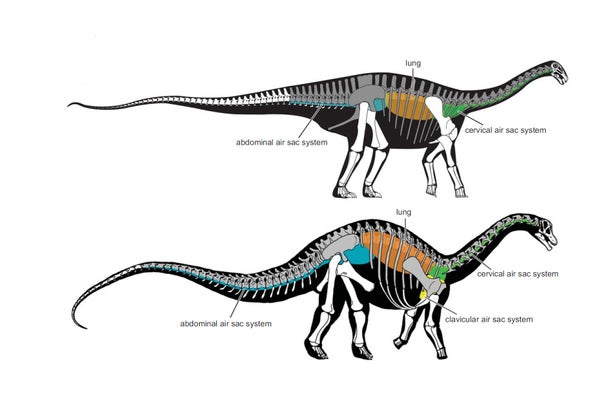
The largest dinosaurs to have ever lived were surprisingly light. I know that might sound strange when we’re talking about animals stretching over 100 feet long and weighing upwards of 45 tons, but it’s true. Immense, long-necked dinosaurs like Supersaurus had extraordinarily light bones assisted by a complex system of air sacs that so pervaded their skeletons that you can see exactly where they would have been even though the actual soft tissues decayed away millions and millions of years ago. This was true for comparatively smaller species, too. Even an "average" sauropod was far larger than an African elephant or Paraceratherium, the largest land mammal of all time. Sauropods were enormous by comparison, and air sacs assisted them at all scales.
Not all sauropod had the same complement of air sacs, though. The anatomy and extent of those structures varied from species to species. And, as paleontologist Luci Ibiricu and colleagues report, a South American sauropod named Katepensaurus goicoecheai had a pneumatic variation never seen before.
If you haven’t heard of Katepensaurus before, that’s probably because it was part of a relatively obscure group of sauropods called rebbachisaurids that lived in South America, Africa, and Europe. They were cousins of Diplodocus that were stomping around during the Cretaceous, after the heyday of North American diplodocids was long over. But apparently some of these dinosaurs took pneumatic skeletons to a degree not seen before in other dinosaurs.
On supporting science journalism
If you're enjoying this article, consider supporting our award-winning journalism by subscribing. By purchasing a subscription you are helping to ensure the future of impactful stories about the discoveries and ideas shaping our world today.

Model and CT scan of a Katepensaurus vertebra. Arrows indicate pneumatic features. Credit: Ibiricu et al 2017
Drawing from external anatomy, CT scans, and digital models of the dinosaur’s bones, Ibiricu and coauthors detected evidence of interconnected air sacs in the transverse processes of Katepensaurus back vertebrae. These are the wings of bone that stick out on either side of a vertebral body and are important muscle attachment sites. No one had seen evidence of pneumatic structures like these before in sauropods. The closest comparable structures had only been seen in avian dinosaurs – birds – and other theropods.
Looked at as a whole, Katepensaurus had a pretty light skeleton. The bones of the dinosaur’s neck and spine give away the presence of an extensive air sac skeleton like that seen in many of its relatives, and the discovery of new air spaces in the vertebrae along the dinosaur’s back only add to the view of sauropods as light for their size. This unique system likely even extended into the tail vertebrae.
But what does this all mean for how the dinosaur lived? Ibiricu and colleagues have some ideas. The most obvious consequence would be that the air sacs allowed sauropods to keep their bones light without sacrificing strength. That’s one of the benefits modern birds enjoy from having extensive air sac systems. And even this fact has further implications. A lighter skeleton requires less muscle power to move, Ibiricu and coauthors note, and therefore reduced the amount of bodily heat produced by motion. Given that Katepensaurus and its exceptionally-airy relatives lived at a time of high global temperatures, anything that would have staved off heat stress would have been an advantage.
Without a living Katepensaurus, this idea is difficult to test. And the researchers point out that other sauropods that lived in the same places and times as exceptionally-airy rebbachisaurids didn’t share the same degree of pneumatic modification, so perhaps the heat hypothesis isn’t the whole story here. Nevertheless, the entire point of paleontology is to try to understand long-dead species as they were in life. That requires putting ourselves in the place of these organisms, thinking of the pressures and needs they experienced on a daily basis. Thinking of how a little extra inflation benefitted Katepensaurus is a step in that direction.
Reference:
Ibiricu, L., Lamanna, M., Martínez, R., Casal, G., Cerda, I., Martínez, G., Salgado, L. 2017. A novel form of postcranial skeletal pneumaticity in a sauropod dinosaur: implications for the paleobiology of Rebbachisauridae. Acta Palaeontologica Polonica. doi: 10.4202/app.00316.2016