
This article was published in Scientific American’s former blog network and reflects the views of the author, not necessarily those of Scientific American
What did pterosaurs eat? It’s a simple enough question, and one that comes attached to just about any restoration of these ancient flying reptiles. We love to see them soar and squabble, but at some point they had to get dinner.
But when it comes to direct evidence, the record of pterosaur meals is pretty slim. Gut contents and petrified poop found in association with pterosaur fossils are hard to find, and the fact that many pterosaurs had toothless beaks means we can’t have a look at their chompers to make rough insectivore/herbivore/carnivore distinctions. Most interpretations of pterosaur diets are hypotheses that require additional testing – or some fortuitous fossils – to verify. Now a new paper by Martin Qvarnström and colleagues offers new evidence of at least one pterosaur species was dining on.
The fossils themselves come from Wierzbica Quarry in Poland. They aren’t bones, but instead are a mix of pterosaur tracks and fossilized feces (called coprolites, if you want to get technical) that were deposited in this spot over 152 million years ago. And when the researchers used advanced imaging tech to look inside those fossil feces, they found an assortment of tiny invertebrates that tells us something about what the local flappers were eating.
On supporting science journalism
If you're enjoying this article, consider supporting our award-winning journalism by subscribing. By purchasing a subscription you are helping to ensure the future of impactful stories about the discoveries and ideas shaping our world today.
Qvarnström and coauthors found that the coprolites were packed with small, shelled animals called forams, as well as bristles from worms and carapaces from crustaceans, bivalves, and other watery invertebrates. Whoever left the prehistoric poops was subsisting on small fare in bulk rather than loading up on larger entrees, avoiding the Mesozoic carving station and going in for Jurassic tapas.
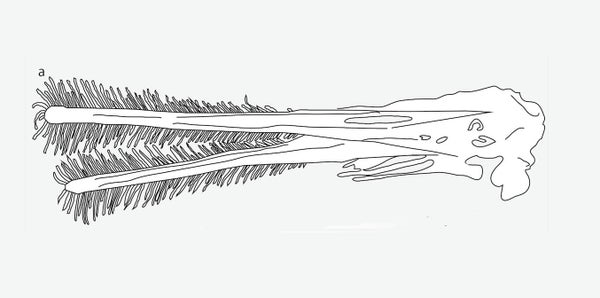
From the abundant tracks found at the same spot, the coprolites were probably left by pterosaurs. What species of pterosaur, though, is another question. There are no body fossils at the site. There’s no skeleton to flesh out. But if the feces and the tracks go together, Qvarnström and colleagues propose, then the pterosaur was probably some kind of ctenochasmatid – a specific group of pterosaurs with lots of small, closely-packed teeth that look well-suited to filter-feeding. These pterosaurs were acting like Jurassic flamingos, tottering around and sifting out little morsels from the shallows.
It’s easy to think of the Mesozoic as a time of aberrations and monsters. Even paleontologists kept this frame of the ongoing reptilian ages for the first half of the 20th century, wondering why scaly oddballs prospered for so long while mammals were waiting in the wings. But something as simple – and even icky – as a piece of Jurassic crap can help us bridge a connection to a world we’ll never see firsthand, where something unfamiliar meets part of our modern experience. This is how the Mesozoic world comes alive, science feeding our avid imaginations.