
This article was published in Scientific American’s former blog network and reflects the views of the author, not necessarily those of Scientific American
What did dinosaurs sound like? This was one of the many questions spinning around my little brain when I first visited the fossil halls of the American Museum of Natural History as a kid. There didn't seem to be a good answer to the query. Things like muscles, skin, and at least some organs could be filled in through fossil clues and the fact that dinosaurs were real animals, but aspects of their lives like color and sound... traces of those facets of dinosaur life had largely vanished. Sound, so far as I would eventually learn, could only be reconstructed if dinosaurs had a bony crest or other feature for making those noises. Saurian hoots, snorts, and roars were calls that could only exist in my imagination. But while the sounds of the Mesozoic world are still largely unknown to us, a fossil found in Antarctica helps add a little more focus to the fuzzy question of what noises dinosaurs made.
Of course, in the paragraph above I was only referring to the extinct, non-avian dinosaurs. Living dinosaurs - birds - surround us, and they tweet and caw and sing their hearts out. Many of them do so thanks to an organ called a syrinx - a bifurcated set of pipes at the base of a bird's trachea. Yet alligators and crocodiles - the closest living relatives of the whole dinosaur group - lack this specialized organ, instead grumbling through a larynx. This raises the question of whether the syrinx is unique to birds or something inherited, like feathers, from non-avian dinosaurs.

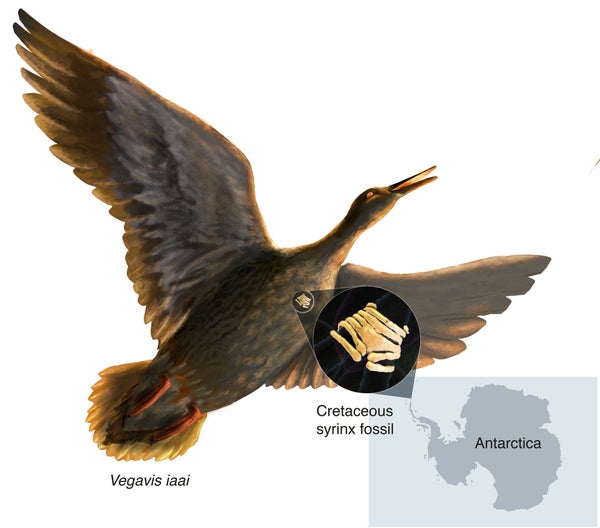
The syrinx of Vegavis in situ and reconstructed. Credit: Clarke et al. 2016
Enter MACN-PV 19.748. That's the name of a very special specimen of Vegavis found in the 69 to 66 million year old rock of Antarctica. Not only is the skeleton of this Cretaceous duck relative exceptionally complete, but, as paleontologist Julia Clarke and colleagues report, it preserves a syrinx in three dimensions - the oldest representation of the structure ever found.
For something so ancient, the paleontologists write, the syrinx of Vegavis looks relatively modern. The two shunts of the structure are asymmetrical, like seen in some modern birds, and the fossil syrinx also has fused rings that anchor the vocal folds in living avians. Exactly what Vegavis sounded like isn't clear, but the anatomy is reminiscent of what's seen in female ducks today.
So what does this mean for non-avian dinosaurs? The conspicuous lack of similar structures in the terrible lizards might be an anatomical clue. Even though fossil birds from the past 66 million years, such as the duck relative Presbyornis, have been found with delicately-preserved tracheobronchial rings intact, non-avian dinosaurs buried in similar environments have yet to be found with any such structures. This might because those rings often aren't well-mineralized in species without a syrinx, Clarke and coauthors write, so this might indicate that the syrinx evolved relatively late in dinosaur history along the bird line.
On supporting science journalism
If you're enjoying this article, consider supporting our award-winning journalism by subscribing. By purchasing a subscription you are helping to ensure the future of impactful stories about the discoveries and ideas shaping our world today.
"This hypothesized pattern would not only mean a very different aural landscape in Cretaceous forests, but may inform patterns in the acquisition of complex visual and vocal communication more generally," the paleontologists write, meaning the way dinosaurs chatted to each other may have been stranger than anything we can imagine. Then again, the fossil record has a habit for surprising us with what can be preserved. In time, with better fossils in hand and new questions buzzing their brains, paleontologists might be able to orchestrate a Cretaceous chorus.
References:
Clarke, J., Chatterjee, S., Ti, Z., Riede, T., Agnolin, F., Goller, F., Isasi, M., Martinoni, D., Mussel, F., Novas, F. 2016. Fossil evidence of the avian vocal organ from the Mesozoic. doi: 10.1038/nature19852
O'Connor, P. 2016. Palaeontology: Ancient avian aria from Antarctica. Nature. doi: 10.1038/nature19480
