
This article was published in Scientific American’s former blog network and reflects the views of the author, not necessarily those of Scientific American
Spinosaurus has always been weird. From the time the first bones of this Cretaceous carnivore were named in 1915, it has stood out as one of the most bizarre dinosaurs of all time. It’s hard to ignore a sail the size of a small billboard jutting from a theropod’s back.
The dinosaur has only gotten stranger in the century since its initial identification. New fossils and an expanded dinosaur family tree altered images of Spinosaurus from an Allosaurus-lookalike with some extra flair into a crocodile-snouted, heavy-clawed semiaquatic superpredator. Then in 2014, a new image - announced in Science and further ballyhooed by National Geographic - made Spinosaurus the first known non-avian dinosaur that may have specialized in a semiaquatic lifestyle, its short legs and strange new proportions suiting it to the water rather than the land. (Of course other dinosaurs - like giant sauropods - had been considered as waterlogged in the past, but the new Spinosaurus seemed to have adaptations to life in the water as opposed to just being placed there on a hunch.) This dinosaur didn’t wade along the shore like a Cretaceous grizzly, this new image proposed, but a skilled swimmer that nabbed giant lungfish and other prey among the depths of lakes and rivers themselves.
But the broader paleontological community was rightly skeptical of the new interpretation from the outset, and a new analysis suggests that Spinosaurus wasn't very skilled in the water, after all.
On supporting science journalism
If you're enjoying this article, consider supporting our award-winning journalism by subscribing. By purchasing a subscription you are helping to ensure the future of impactful stories about the discoveries and ideas shaping our world today.
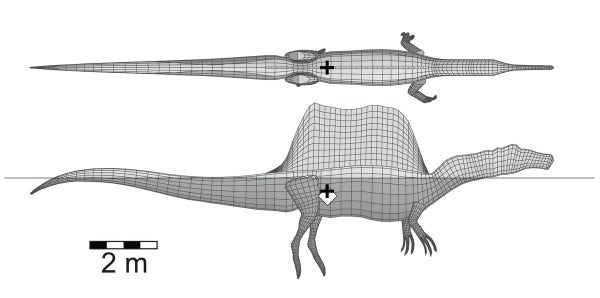
Paleontologist Donald Henderson, who has written a spate of papers about the varying abilities of dinosaurs in water, used digital models of Spinosaurusand other theropods to investigate how the great sail-back would have fared in the water. These included models of close relatives - such as Suchomimus - and terrestrial theropods like Tyrannosaurus, as well as an alligator and emperor penguin facsimiles as a check on the methods. What Henderson found runs counter to images of aquatically-adept spinosaurs.
As it turns out, Spinosaurus was a perfectly adequate floater. The dinosaur - like the other non-avian theropods analyzed in the study - would have been able to freely float in water while keeping its head above the surface. “Spinosaurus is certainly able to float and breathe with the head above water,” Henderson writes. But this isn’t really that remarkable, given theropods of varying size were easily capable of doing the same. They also all shared a center of mass oriented in front of the hips, indicating that Spinosaurus - like Tyrannosaurus, Allosaurus, and the rest - was perfectly capable of walking around on land.
Swimming is another story. For one thing, it seems that Spinosaurus would've had a hard time sinking in order to pursue prey underwater. While the alligator model sank when its lung volume was deflated between 40 and 50 percent, for example, the digital model of Spinosaurus wouldn't sink even when its lungs were deflated 75 percent. Needless to say, this is a major impediment to chasing after fish below the surface. And that’s not all. Spinosaurus was not very stable in the water, Henderson found, no doubt in part to the huge sail jutting from its back. Henderson’s digital model had a tendency to roll on its side without some kind of motion to prevent it. Plunk a Spinosaurus in the water, in other words, and it’d soon flop over without some motion to prevent tipping.
This doesn’t mean that Spinosaurus was a complete landlubber. The overall picture of the dinosaur’s anatomy, as well as clues from related species, make it likely that Spinosaurus was closely tied to waterways and grabbed much of its food from along the shores. But the image of Spinosaurus as an immense and immaculate swimmer, better suited to paddling through lakes than walking on land, doesn’t hold up. And that only makes Spinosaurus stranger still. Given that paleontologists have yet to uncover anything close to a complete skeleton - popular restorations and reconstructions are based on composites of multiple specimens and spinosaur species - we are really just getting to know Spinosaurus. The dinosaur will continue to metamorphose just as the science studying it does.