
This article was published in Scientific American’s former blog network and reflects the views of the author, not necessarily those of Scientific American
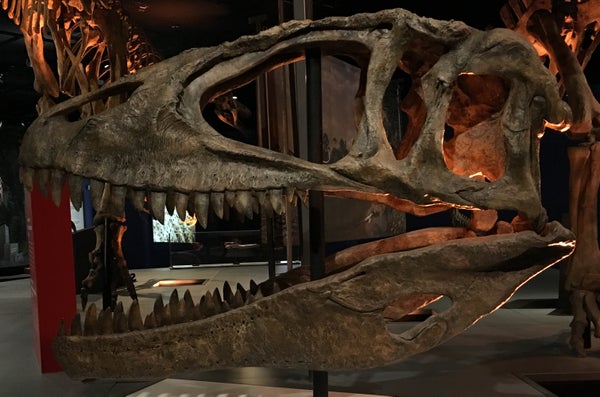
When I was a young fossil fan, trying to keep up with the flood of new discoveries coming in from Africa, South America, and Asia, there was one particular group of dinosaurs that was especially exciting. These were the carcharodontosaurs, the “shark-toothed lizards” - carnivorous giants like Carcharodontosaurus, Giganotosaurus, and more, toothy and ready to challenge title-holder Tyrannosaurus for the status as the largest terrestrial predator of all time.
That initial flurry of fandom faded some as these dinosaurs have found themselves within the Mesozoic rank and file. Novelty only goes so far when a new dinosaur is announced on the average of every two weeks. But the gradual accumulation of new fossils and shifting interpretations of what these dinosaurs were like has started to allow us to understand the lives of the large and vicious outside the purview of our precious tyrannosaurs. In a recently-published survey, paleontologist Carlos Roberto dos Anjos Candiero and colleagues track where carcharodontosaurs came from and where they went.
Part of the reason we never appreciated these impressive dinosaurs until recently is because we weren’t looking in the right places. So much of what we expect about the Age of Dinosaurs comes from the Northern Hemisphere - North America, Europe, and parts of Asia gave us our most beloved Mesozoic rock stars. It’s only been more recently, as paleontology has taken hold and flourished in the Southern Hemisphere, that we’ve started to better assess the grand variety of dinosaurian life.
On supporting science journalism
If you're enjoying this article, consider supporting our award-winning journalism by subscribing. By purchasing a subscription you are helping to ensure the future of impactful stories about the discoveries and ideas shaping our world today.
The oldest carcharodontosaur known, Candiero and coauthors point out, is an animal called Veterupristisaurus found in the Late Jurassic rock of Africa. This seems to be the point of origin of carcharodontosaurs, among the ancient southern landmass of Gondwana, where they gradually diversified and became the apex predators of their ecosystems. From about 125 to 90 million years ago, they were the baddest dinosaurs on the block - relatives of Allosaurus that carried on a carnivorous tradition at even larger sizes. And from their starting point in ancient Africa, they spread through Gondwana to lands that would eventually become South America and further still into Europe, North America, and Asia.
Not that carcharodontosaurids were the only predators around. They overlapped in space and time with the crocodile-snouted spinosaurs and the bulldog-faced abelisaurids. How these large carnivores divvied up the same habitats is a persistent question that we still don’t have a handle on. Nor is it clear why carcharodontosaurids eventually faded away during the latter part of the Cretaceous. They were huge and adapted to flesh-ripping, rather than bone-crushing, just as their earlier relative Allosaurus was. But tyrannosaurs had come to dominate in North America and Asia, while neighbors of the carcharodontosaurs - like the abelisaurids and other forms of allosaur - were able to persist. This is the way it goes - whenever paleontologists spot a story of great evolutionary success, we are left to wonder what ended the winning streak.
