
This article was published in Scientific American’s former blog network and reflects the views of the author, not necessarily those of Scientific American
The scariest part of JAWS is right there in the title. Rows and rows of triangular teeth closing in from the ocean dark, ready to swallow us whole or worse. But there were creatures with mouths far more frightening than that of any shark. They lived at a time before fish, even before backbones, and they fed on their neighbors with a nightmare apparatus of moving mouthparts.
In technical terms, the animals I'm talking about are called lobopodians. Way back in the Cambrian, when animal life was running riot for the first time, these creatures looked like worms with stubby little legs and mouths composed of circlets of teeth and plates. As paleontologist Jakob Vinter points out, though, a quicker and more-or-less accurate image is of Star Wars' ravenous Sarlaac - it's teeth all the way down. Pambdelurion whittingtoni is a perfect example, and happens to be the subject of a new paper by Vinther and colleagues that resolves a longstanding mystery.
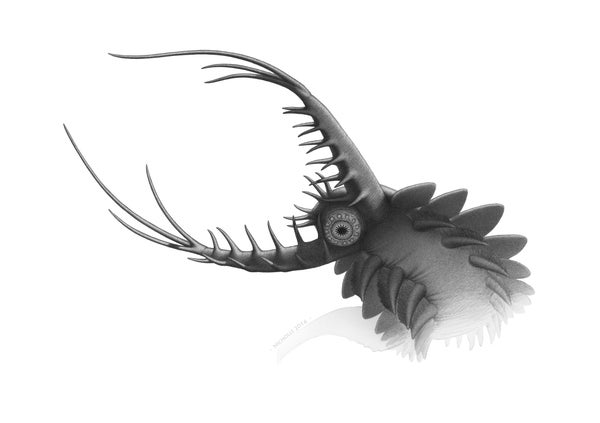
Since the mid-90s paleontologists have been finding tooth plates in the roughly 515 million year old Chengjiang deposits of China. At first these seemed to belong to an animal like Anomalocaris - a bug-eyed invertebrate swimmer with two grasping appendages dangling from either side of a circular mouth. In 2006, however, paleontologist Hou Xianguang and coauthors proposed that these pieces belonged to something called a priapulid - or penis worm - they named Omnidens amplus. Without a body, though, it was hard to be sure what it was for sure. Now fossils from Greenland described by Vinther and colleagues have settled the question.

The mouth of Pambdelurion whittingtoni, showing A/B) the fossil, C) mouth orientation, D) eversion sequence. Credit: Vinther et al. 2016
On supporting science journalism
If you're enjoying this article, consider supporting our award-winning journalism by subscribing. By purchasing a subscription you are helping to ensure the future of impactful stories about the discoveries and ideas shaping our world today.
Even though hundreds of Pamdelurion fossils have been found in the 520 million year old rock of Greenland's Sirius Passet, only four provide a detailed look at the mouthparts. Still, even this small sample was enough to see that this worm-like animal had a frightening gape. The head of Pambdelurion had two flaps lined with large spikes, its mouth situated behind and beneath. That mouth could protrude - that's why it's found in varied orientations in different fossils - and had three layers consisting of a set of outer plates, a ring of inner plates, and a complement of small points. It just so happens that Omnidens from China have the same arrangement, indicating that the two were relatives in the lobopodian family tree.
But how did these creatures eat? Vinther and colleagues include a three-step "sequence of eversion" in their paper. The circular structure looks intimidating enough at rest, but Pamdelurion could push their creepy mouth cone outward into a kind of pyramid before flinging open to present their spikes and close around smaller, softer prey. And while Pamdelurion didn't reach Sarlaac size - Vinther and colleagues estimate the invertebrate was a little more than three feet long - the thought of all those plates is unsettling at any scale. As I've said before, maybe Hollywood monster makers should bone up on their paleontology if they want to bring us more silver screen terrors.
Reference:
Vinther, J., Porras, L., Young, F., Budd, G., Edgecombe, G. 2016. The mouth apparatus of the Cambrian gilled lobopodian Pambdelurion whittingtoni. Palaeontology. doi: 10.1111/pala.12256
